
Baseball has had a presence in Western Pennsylvania since shortly after the American Civil War.
Several amateur teams, including the Enterprise, Xanthas, and Olympics regularly played in Union Park, on the North Side of Pittsburgh. Only back then, the North Side was actually its own separate city. It was known as Allegheny City up until Pittsburgh annexed it in 1907.
Professional baseball, however, first arrived in 1876, when Denny McKnight and several other local organizers formed the Allegheny Base Ball Club. This move was made just mere weeks after Pittsburgh lost a bid to land a pro team in the National League.
The team was officially named Pittsburgh Allegheny, and their first season in existence saw them act as an independent ball club. They had no league, and relied on competition with other minor league/amateur teams in the area. They defeated the local Xanthas 7-3 in their first ever game on April 15th, 1876 at Union Park.
The team became a member of the International Association for the 1877 season, but by that point, their days were already numbered. Despite a solid team performance for a 13-6 record in the IA that season, the team was rife with player defections to other local, more established clubs, and the team officially folded in 1878; the IA wasn’t far behind.
McKnight wasn’t done, however. In October of 1881, McKnight sat at the St. Clair Hotel in Pittsburgh and called a meeting to form a new baseball club in the city.
This new version of an Allegheny team became a founding member of the American Association, which was created to go up against the more established National League.
The identity of the new team was often blended between Pittsburgh and the neighboring Allegheny City. Officially speaking, the team was founded as the Allegheny Base Ball Club of Pittsburgh, the team only used Allegheny as their name in official league standings.
This would remain the case for several of the team’s opening years, hence the name of this whole series.
They were unofficially known as the Alleghenys, as it was common practice for a club with no name (i.e., “Pirates”) to have just a pluralized version of their city name.
Finally, the American Association was ready to begin play in 1882. The AA was comprised of six teams in its first year, based in Cincinnati, Louisville, Philadelphia, St. Louis, and Baltimore.
Al Pratt, who was involved in the founding of the team, was named the manager.
Allegheny City played their first ever game at the Bank Street Grounds on May 2nd, 1882 in Cincinnati, beating the only other nameless team in the AA 10-9.
They split the four game series with Cincinnati before playing their first ever home game on May 10th at Exposition Park, beating the St. Louis Browns 9-5.
By the time May was out, Allegheny City had gone 6-5, but were looking down the barrel of a lengthy road trip to start June. Twenty days and 11 games saw the Alleghenys drop to 10-13, including a 21-4 beating at the hands of Cincinnati on the final away game.
Unfortunately for the Alleghenys, their only real home stand of June also saw them drop three of four against the Philadelphia Athletics.
Allegheny City also made some roster moves as the summer crept in; first baseman Jake Goodman, who was batting .317 in 41 at bats with the team, was released. Goodman was a member of the first Pittsburgh Allegheny back in 1877, before finding his way back to the area to join the new team.
Goodman would never play in the major leagues again, but did continue to play minor league ball before his career was cut short in 1884. Goodman was hit in the head by a pitch, which caused serious complications, including palsy; Goodman died as a result in 1890.
Pitcher Morrie Critchley, who pitched one game (a complete shut out) was also released by the club. He would go on to finish the season in St. Louis, where he pitched 34.0 innings for them.
The team was able to be back home in Exposition Park for the vast majority of July. They played just three games on the road, the other 12 were back at home. They dropped two out of three against Baltimore earlier in the month, before bouncing back and winning the series vs St. Louis.
They couldn’t keep the momentum going, however, and they lost three of four in their final home series against Cincinnati before paying Baltimore a visit.
Allegheny City released two more players in July, the last two documented transactions from the team.
Pitcher Harry Arundel, who tossed 118.2 innings for the Alleghenys with a 4.70 ERA and 3.6 strikeouts per nine innings was released.
Outfielder Charlie Morton was also let go. He left to go reunite with his old teammate Morrie in St. Louis.
Just an interesting side note: there have been two players named Charlie Morton in major league history. Both of them played for the Pirates franchise.
The Alleghenys opened August with three of four wins in Philadelphia, but any progress they made in the standings was lost when they dropped four of five against Baltimore at home.
They continued to go up and down, but could never quite put together a lengthy winning streak, and ended the month of August 29-34. But something clicked as they entered their final month of play.
The Alleghenys went 7-0-1 from September 1st to the 14th, and September 12th marked the first day since June 12th that the Alleghenys were above .500. They finished the season with a six game home stand against Louisville, losing four of six.
The Alleghenys suffered some harsh losses at the hands of the Eclipse, including a 20-6 loss and a 13-3 loss. However, the team did win their final game of the season, the second game of a double header, 7-1.
They finished the season exactly at .500, going 39-39-1, which was good for fourth in the AA. That late season surge by the Alleghenys gave them a better road record (22-19) than home record (17-20).
Outfielder Ed Smartwood led the way in the batting department. He recorded a .331 batting average, and was the Alleghenys’ leader in doubled (18), home runs (4), and walks (21).
Fellow outfielder Mike Mansell notched 16 triples, however, which was the team lead there.
Chappy Lane, a Pittsburgh native, had the lowest batting average (excluding pitchers) at .175. He took over at first base largely after the release of Jake Goodman, but struggled to bring any kind of consistency at the plate.
Ironically, Goodman and Morton were the second and third highest batting averages on the Alleghenys, and Arundel had the highest batting average among pitchers. And yet, all of them were released.
On the mound, Denny Driscoll had a tremendous year, pitching 201.0 innings to a 1.21 ERA. Harry Salisbury also had an amazing year though, going for 335.0 innings with a 2.63 ERA and 135 strikeouts.
Below is a full-length roster of the 1882 Allegheny City ball club:
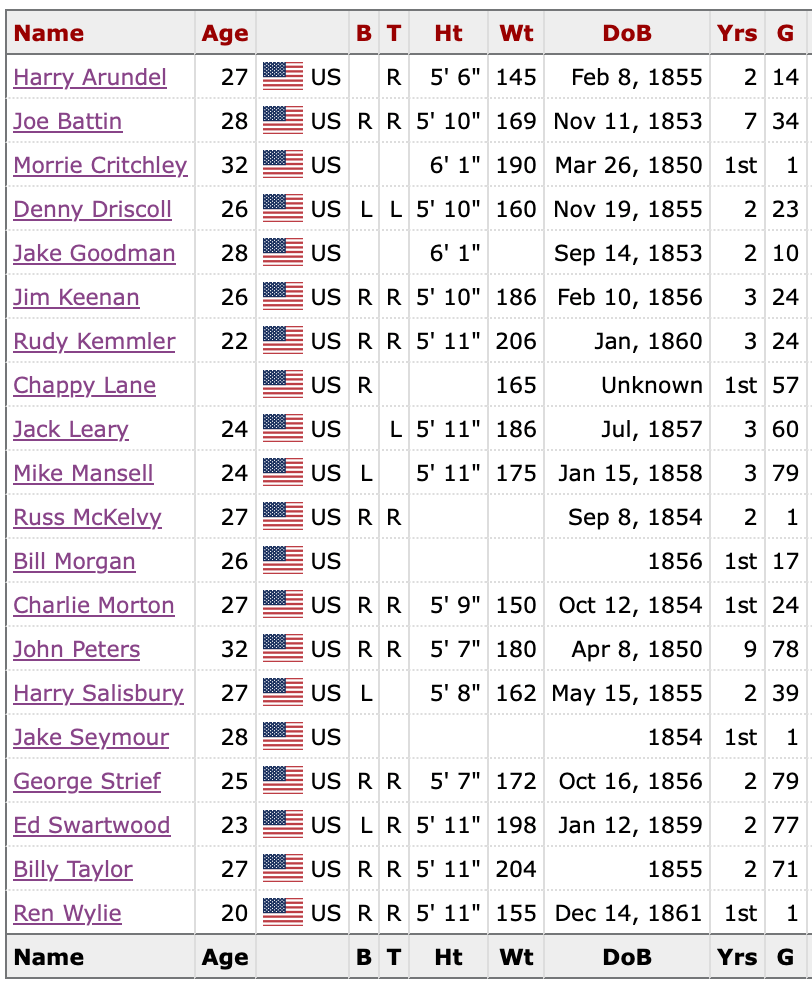
Four players on the roster were born in or around the Pittsburgh/Allegheny City area. Chappy Lane and Jake Seymour were both from the city of Pittsburgh; Ren Wylie was from Elizabeth PA, and Russ McKelvy was from Swissvale, PA.
Despite the Alleghenys only posting a .500 record, this would be one of their better seasons in the American Association. As we will see in the years to follow, the Alleghenys would fall on some rather hard times before eventually jumping ship to the National League.

 Fifth Avenue Sports
Leave a comment