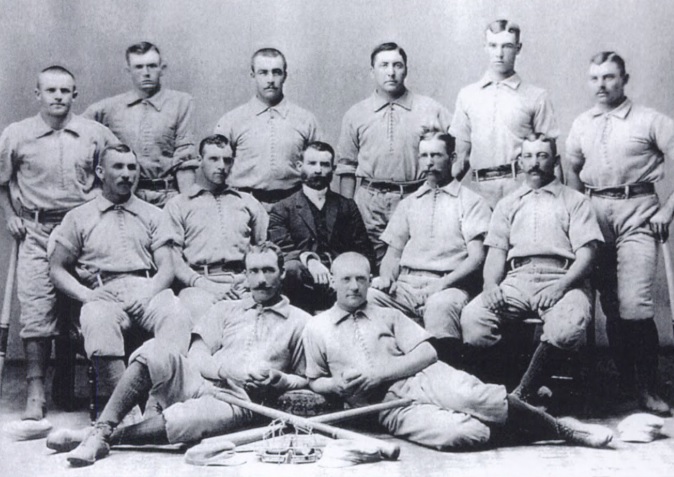
Things have not been going well in Allegheny City during their first three years in the American Association.
Their ballparks are burning down and flooding, the team is rapidly approaching a double digit amount of managers, and the team is cycling through countless players trying to find any balance that worked.
Not to mention, the franchise has yet to have a winning season. They finished a perfect .500 in their inaugural year, but it has been a disaster ever since. The Alleghenys finished their 1884 campaign with a record of 30-78-2, good for 11th out of 12.
Stability was ever so slowly starting to cement itself for the riverside club. Manager Horace Phillips, who took over down the stretch and acted as the team’s fifth manager last season, was returning for 1885.
However, roster changes still had to be made. Allegheny City needed serious help.
Luck would have it, though, that the Alleghenys would be able to take advantage of a retracting AA. After getting bold and expanding from eight teams to 12 for the 1884 season, the AA was going back down to eight teams.
- The Indianapolis Hoosiers, after finishing last place in the AA in their only season of operation, folded.
- The Richmond Virginians, who were imported into the AA mid-season from the Eastern League to replace the folded Washington Nationals/Statesmen, returned to the EL for 1885.
- The Toledo Blue Stockings, who were a minor league team before joining the AA in 1884, returned to playing minor league ball before eventually folding after the 1885 season.
The Columbus Buckeyes, meanwhile, found a way to get some money out of the deal before calling it quits. On the brink of folding, the Buckeyes sold a majority of their roster to Allegheny City after the conclusion of the 1884 season.
Officially, the Alleghenys had acquired:
- Fred Carroll
- Jim Field
- Rudy Kemmler
- Bill Kuehne
- Fred Mann
- Ed Morris
- Frank Mountain
- John Richmond
- Pop Smith
- Tom Brown
Columbus netted $8,000 for essentially selling off their entire roster to Allegheny City.
The team that the Alleghenys were buying was coming off an 1884 season that saw them go 69-39-2, which was good for second place in the AA.
The two teams also had several previous ties; now-Alleghenys manager Horace Phillips was the Buckeyes’ manager in 1883, and Columbus catcher Rudy Kemmler had played for Allegheny City during their inaugural season in 1882.
By the time the Alleghenys were set to hit the field in 1885, only four players had ever suited up for the team before, and only three players had returned from the 1884 season.
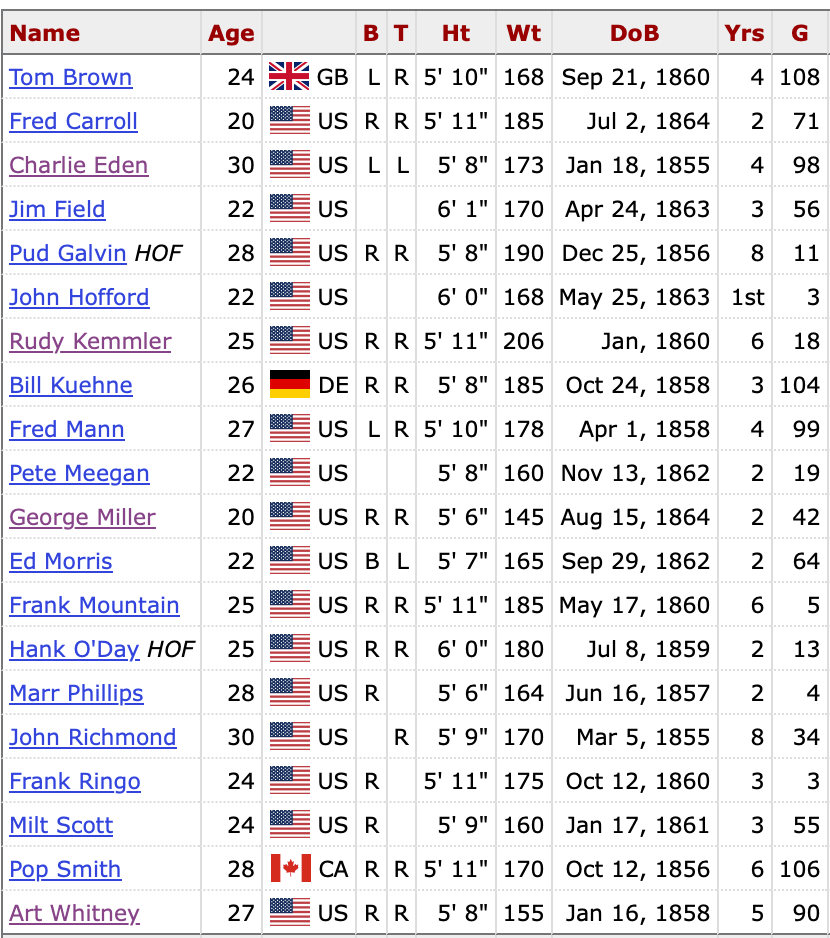
Below is a look at the roster (purple denotes the player played for Allegheny City before):
The team also decided that change simply on the field wasn’t enough. One step removed from changing ballparks again, the Alleghenys changed the name of Union Park to Recreation Park, the name that more people would recognize today.
Ironically, the change might have helped the ex-Buckeyes players that the Alleghenys had acquired. The Buckeyes played in a ballpark called Recreation Park during their time in Columbus.
The Alleghenys opened their 1885 season with a 7-0 win in St. Louis, and over the course of their seven game road trip to start the year, they also paid a visit to Louisville (who rebranded from the Eclipse to the Colonels) and Cincinnati.
In their first game at the newly renamed ballpark, the Alleghenys beat Louisville 4-0, and the team had a long time to spend at home as the season progressed. From April 28th to May 30th, Allegheny City played all but one of their 23 games in the confines of Recreation Park.
This was a common theme for the Alleghenys this season; 1885 was full of very lengthy home stands and road trips.
During their first very extended home stand, Allegheny City delighted in a four game and seven game winning streak that propelled them to a 19-12 record at the end of May. The Alleghenys scored 10+ runs five times, including doing so in three straight games against the Metropolitans in a series they outscored New York 43-13.
Help support the Fifth Avenue Sports publication!
Make a monthly donation
Make a yearly donation
Choose an amount:
Or enter a custom amount
Contributions help ensure that Fifth Avenue Sports can continue to survive and grow in the sports media realm. I cannot possibly thank you enough for your support and generosity in supporting my work!
Your contribution is appreciated.
Your contribution is appreciated.
DonateDonate monthlyDonate yearlyTowards the end of the month, the Alleghenys pulled off sweeps of both Philadelphia and Baltimore soon before heading back on the road for two and a half weeks.
The team started with a 3-1 series win against Brooklyn, but they faded fast, splitting a series in Baltimore and losing the battle in Philadelphia.
That concerning skid kept up when they returned home, losing three straight to St. Louis before turning it around to win six of the next seven. This span also saw the Alleghenys make their first reported transactionm of the season.
On approximately June 25th (the exact date is uncertain), the Alleghenys purchased first baseman Milt Scott from the National League’s Detroit Wolverines for an unknown amount of money.
Not long after, the team also purchased Hall of Fame pitcher Pud Galvin from the NL’s Buffalo Bisons for either $600 [sic] or $5,000 according to Baseball Reference. How the range could be so big is beyond me, but Galvin was now in Allegheny City.
Another ultra-lengthy home stand saw the team go 16-8, including sweeping Cincinnati early on and ending their time at home by sweeping Brooklyn.
An underwhelming road trip saw the Alleghenys go 5-8 from late July to mid August. The team then came home for a much shorter stay back at home, spending just six games at Recreation Park.
Allegheny City went 4-2 in that stretch, including a sweep of Louisville before making a quick trip to Cincinnati, where they suffered harsh back to back losses.
Opening up September, the Alleghenys had a three game against the team that had just beat them by a combined 24-6 in their last two games. Cincy took two of three from the Alleghenys at home, and the team played their last game in friendly territory on September 5th, a 6-2 loss.
The skids in July and August had really put an end to any kind of fleetinf hopes that the Alleghenys would have had in catching the St. Louis Browns, who wound up running away with the AA pennant. The race hadn’t really been close since July 1st.
Despite that, the team was still poised to record their first winning season since joining the AA. The team stood at 52-42 when they traveled to New York State for a weird back and forth between playing the Metropolitans and Brooklyn, but the team was taken for a wild ride, losing seven of nine in that stretch to drag them to just five games above .500.
A trip to Baltimore didn’t serve them much better, seeing the Alleghenys losing three of four.
With one final series in Philadelphia, the Alleghenys had to win just one game to secure a winning season. And it was that bare minimum that the team achieved, winning 6-3 on September 29th to clinch a winning season, but that was all as the team lost the other three games to finish the 1885 season 56-55.
Despite the late season collapse, Allegheny City placed third overall in the American Association. This year saw a ton of parity around the surviving clubs; just three wins separated the third place and sixth place teams.
However, even with the bulk of the teams being middle of the pack, St. Louis ran away with the AA pennant at 79-33, and Baltimore was once again in last place.
Outfielder Tom Brown, one of the ex-Buckeyes purchased, led the team in batting average, at .307. Of the five total home runs the Alleghenys hit that season, Brown had four of them, and also far and away led the team in RBI, at 68.
That other home run belonged to fellow ex-Buckeye Jim Field, who split first baseman duties with the incoming Scott.
Other notable performers include third baseman Bill Kuehne, who racked up 19 triples to lead the team. Interestingly, his 19 triples were also more than anybody on the team had in doubles.
A vast change from the ways along the Allegheny in 1884, the team had only used 20 total batters (including pitchers) this season, which was exactly league average.
On the mound, ex-Buckeye Ed Morris was the main guy pitching for the Alleghenys. He pitched 581.0 innings for the team, notching to a 2.35 ERA. He started (and completed) all 63 of the games he pitched, and put together seven shutout games.
Overall, team pitching was very solid. All of Allegheny City’s starting pitchers had a sub-4.00 ERA, and the argument could be made that Galvin, the team’s purchased pitcher during the season, was actually the worst of the group. Of course, that wouldn’t stay the case.
I haven’t usually mention the World Series results, but for this season I think it’s worth noting. In 1885, the World Series pitted the AA’s St. Louis Browns against the NL’s Chicago White Stockings.
It is the only World Series to officially be scored as a 3-3-1 series tie. That tie came in Game 1 came after Chicago had rallied to score four runs in the eighth inning to tie the game at 5-5. The game was called after that due to darkness, and amazingly, these guys did not learn their lesson.
The following game is where the dispute occurred, however. In the sixth inning of Game 2, St. Louis manager Charles Comiskey called for his team to vacate the field in protest after several controversial (and reportedly incorrect) calls were made by umpire Dave Sullivan.
The game, assumed to have been forfeited by the Browns (who were also down 5-4 at the time), was awarded to Chicago, who dropped Games 3 and 4 but rallied to win three straight, including blowing out the Browns 13-4 in Game 7.
St. Louis, however, disputed that they had forfeited Game 2, and claimed that they were the World Series winners for 1885. The teams wound up splitting the prize money.
St. Louis, for what its worth, would get back to the World Series the following season and beat the NL representative
The 1885 World Series saw games played in four different cities, with the Pittsburgh/Allegheny City area hosting Game 5 at Recreation Park. A cold day in late October was called after the seventh inning due to darkness, with Chicago as the victor.
If you’d like some further reading on this crazy series, Eric Chesterton over at MLB.com did a piece on the 1885 World Series a few years ago.
(Featured photo is of the 1884 Columbus Buckeyes, many of whom would become Alleghenys in 1885)




 Fifth Avenue Sports
Leave a comment