
History largely sees 1887 as the official start of Pittsburgh Pirates baseball. Even though the team was yet to be known as the Pirates, or even be recognized as Pittsburgh, this is the year that is seen as the beginning of this team.
Why? Because 1887 saw the first year of baseball in the National League in this town, the same league that the Pirates still belong to today.
While the American Association was still years away from collapsing, early cracks in the foundation were beginning to show, and our old friends over on Allegheny City were about to make a very historic change.
The Alleghenys became the first AA team to jump to the older and (supposedly) stronger National League, which was looking to recoup the loss of the Kansas City Cowboys, who had folded and been forced to sell their players back to thee league.
The Cowboys been invited to the NL on essentially a trial basis for the 1886 season. It wound up being their only year in existence.
Allegheny City would take their spot, and with the NL’s St. Louis Maroons moving to Indianapolis to become the Hoosiers (a revival of an old AA team), the National League was set for the 1887 season with the following eight teams:
- Detroit Wolverines
- Philadelphia Phillies
- Chicago White Stockings
- New York Giants
- Boston
- Allegheny City
- Washington Nationals
- Indianapolis Hoosiers
Despite the changes happening around them, not a lot of change came to Recreation Park and the Alleghenys roster.
Help support the Fifth Avenue Sports publication!
Make a monthly donation
Make a yearly donation
Choose an amount:
Or enter a custom amount:
Contributions help ensure that Fifth Avenue Sports can continue to survive and grow in the sports media realm. I cannot possibly thank you enough for your support and generosity in supporting my work!
Your contribution is appreciated.
Your contribution is appreciated.
DonateDonate monthlyDonate yearlyThe team did make some smaller scale moves, which included purchasing outfielder Abner Dalrymple from Chicago and trading Otto Schomberg and $400 in cash to the St. Louis Maroons (before they relocated) in exchange for first baseman Alex McKinnon.
Much closer to the season, the Alleghenys sent George Van Haltren (who had never played a game for them) and $2,000 in another deal with Chicago, this time netting them legendary pitcher Jim McCormick. The 1887 season would be his last as a big leaguer.
Among players who were returning to the club from last season was Fred Carroll, who switched from being primarily a catcher to a utility player. Position changes occurred for multiple players returning from last year. Sam Barkley moved from second base to first base; Pop Smith moved from shortstop to second base, and Bill Kuehne became a primary shortstop.
To open their season, the Alleghenys hosted Chicago in a 6-2 win at Recreation Park in front of a reported crowd of 9,000. They then hosted a three game series with Detroit, which saw them lose two out of three.
The month of May saw them suffer some challenges in acclimating to their new NL opponents, and they only won two series that month as they got out to a record of 10-14 after their first full month.
Things have certainly started out worse for the Alleghenys, but they would have a lot of work to do, already 9.0 games back of the league leaders.
That improvement didn’t come in June. Though they would win their first series of the month in Indianapolis, they would lose the next four series before finally finding a way to split one with Washington in the tail end of June. To the team’s credit, the Alleghenys were never swept in any of this series losses.
However, that consolation prize wasn’t enough to keep Allegheny City very relevant; a 9-12 month saw their record fall to 19-26.
In the midst of all of this, the team was also losing perhaps their best batter in Alex McKinnon.
When he was healthy, McKinnon was always a terrific batter, but his defense was severely lacking, having committed 53 errors at first base during the 1884 season and 46 in 1886. However, he has been cleaning up his defensive work with Allegheny City, and was on pace to record the lowest error total of his big league career.
However, just as it was starting to all come together for Alex, he fell very ill. McKinnon’s life was tragically filled with illnesses and disease, which severely hampered his baseball career.
During the season, McKinnon had contracted typhoid pneumonia. His last game with the Alleghenys came on July 4th, 1887.
A Boston native, McKinnon returned to nearby Charlestown, MA to tend to his health. At the time he left the team, he was batting .340 with a home run and 30 RBI in 40 games, both team leaders.
The Alleghenys would not win another series until July 12th, when they hammered the New York Giants for a 15-6 win to take their second straight in the Big Apple to claim the three game stand.
McKinnon would pass away on July 24th, at the age of 30. When the Alleghenys learned of his passing, they began to wear black crêpes on their uniforms in honor of him.
It was another lengthy stretch before the Alleghenys would win another series. In a three game series at home vs Boston, Allegheny City pulled off their only sweep of the season. A crowd of 2,000 saw the team record a season-high 23 runs in a 23-3 win at Recreation Park on August 9th, their biggest win of the year.
Boston would remember this game; on an August 27th matchup at the South End Grounds, Boston put up 28 runs on the Alleghenys, who found a way to put up 14 in that wild game.
The month of August was the team’s best on the year. They were a competitive 11-11, their only full-length month that saw them not post a losing record. They also won four different series that month, a season high.
August also saw the only recorded release of a player. Outfielder Tom Brown, who was batting .245 but had almost no power in his bat, was released on August 15th. He ended up with Indianapolis to end the year.
The good vibes in Allegheny City continued into September as the team won four of their first five. They responded to a sweep by the Detroit Wolverines by turning around and sweeping Washington.
The mini roll the Alleghenys were on came to a screeching halt after that though. An eight game losing streak plagued the team before a road trip to Chicago.
A multi-day rainstorm had postponed games between the Alleghenys and White Stockings, leading to back to back double header days between the two. In the end, the teams split both double headers, each getting two games before heading on their merry ways.
A 5-2 win the second game of the double header in front of 1,200 people marked the Alleghenys’ final road game of the season.
They returned to Recreation Park for the final nine games of the season, and although the season was lost long ago, they went on a nice little 6-2-1 run to end the 1887 season. A handful of those games were scheduled for much earlier in th season, but had to be postponed due to rain or wet grounds.
The Alleghenys tied Chicago 7-7 in their season finale, saving their first tie of the season for their last game.
At 55-69-1, team finished sixth in the National League, ahead of the Washington Nationals and Indianapolis Hoosiers. They weree 24.0 games back of the NL winners, the Detroit Wolverines, who won the World Series that year.
Among the NL, Allegheny City ranked just below league average in team batting average, but were far and away in last place in home runs and second to last in team RBI.
Interestingly, however, the Alleghenys were tied with Boston for the least number of players to bat (16) and pitch for the team (5).
Meanwhile on a team level, McKinnon had still led the team in batting average at season’s end, with .340.
Following him was Fred Carroll, who bat .328. Carroll had a dominant year for the Alleghenys, leading or being tied for the team lead in every main offensive statistic.
Carroll led with 6 home runs and 24 doubles, and tied for triples at 15 with Bill Kuehne.
There was a three-way tie for the RBI lead, with Carroll, John Coleman, and Pop Smith all at 54.
The team was very top heavy at the plate, with everyday players like Kuehne (.299) and Coleman (.293) experiencing success, but others like Sam Barkley (.224), Pop Smith (.215), and Abner Dalrymple (.212) also playing regularly but struggling to get anything going.
On the mound, Allegheny City went with a three man rotation, with Pud Galvin. leading the way. He pitched in 49 games for the team with a 3.39 ERA.
Jim McCormick and Ed Morris rounded out the trio, and the two players had virtually identical stats. McCormick’s ERA was 4.30, Morris’ was 4.31.
They pitched 36 and 38 games, respectively, both taking a backseat to Galvin, who was the only Alleghenys pitcher to have a winning record at year’s end.
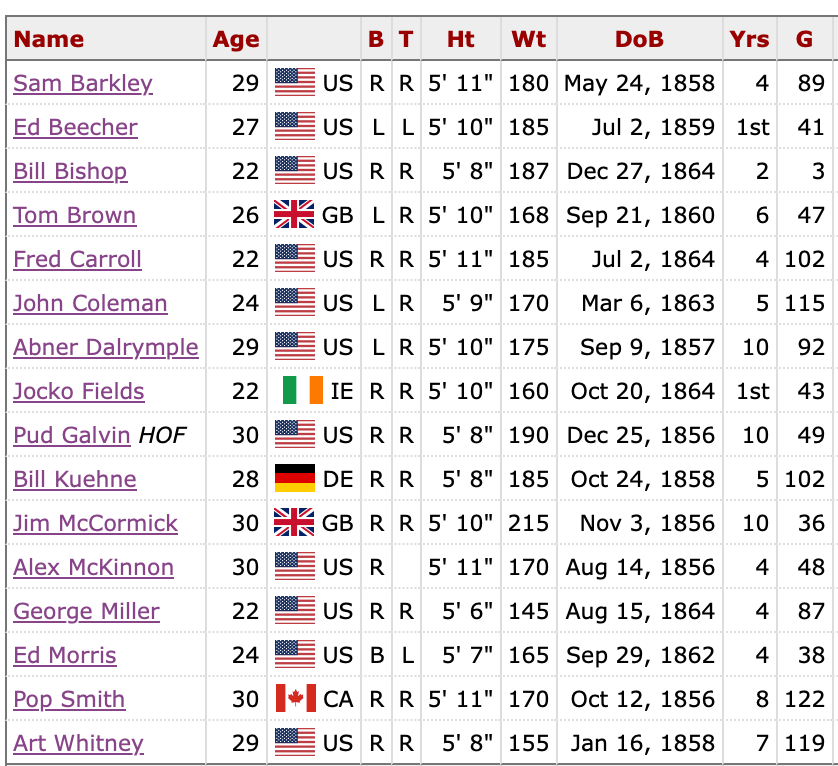
Here’s a full look at the 1887 Alleghenys:
After this season, the Alleghenys went on a bit of a shopping spree in an effort to improve their roster. As for how much that helped, you’ll have to see in the 1888 edition.
(Featured photo of Alex McKinnon from Goodwin & Co.)


 Fifth Avenue Sports
Leave a comment