By the time 1889 rolled around, ownership of the Allegheny City ballclub, which included William A. Nimick, was eager to put a winning team on the field.
The Alleghenys had just one winning season, coming back in 1886, and had none since jumping ship from the American Association to the National League.
Last season, in 1888, the Alleghenys had went on a shopping spree to make additions to their roster. That resulted in a 66-68-5 season, just barely below the .500 mark. But the underwhelming results didn’t stop the Alleghenys from continuing to buy.
Ahead of the 1889 season, the team took serious advantage of the Detroit Wolverines, who were rapidly collapsing financially:
- October 16th, 1888: Purchased Pete Conway and Jack Rowe from the Detroit Wolverines for an unknown amount.
- November 21st, 1888: Purchased Ned Hanlon from the Detroit Wolverines for $2,500.
- March 5th, 1889: Purchased Deacon White from the Detroit Wolverines for an unknown amount.
…And speaking of spending some money, I humbly ask that you support the Fifth Avenue Sports publication
Make a monthly donation
Make a yearly donation
Choose an amount:
Or enter a custom amount:
Contributions help ensure that Fifth Avenue Sports can continue to survive and grow in the sports media realm. I cannot possibly thank you enough for your support and generosity in supporting my work!
Your contribution is appreciated.
Your contribution is appreciated.
DonateDonate monthlyDonate yearlyDetroit wouldn’t make it to the 1889 season, and were replaced in the NL by the Cleveland Spiders, who had jumped from the AA.
Pete Conway was coming off a tremendous season with Detroit, where he pitched 391.0 innings to a 2.26 ERA, and he found a way to bat .275 in 167 at-bats.
Pete Conway pitched very sparingly for the Alleghenys, but the reasons for that are something we will dive in to later on.
Deacon White and Jack Rowe weren’t everyday position players for the club either, but both were coming off great seasons with the Wolverines. White had batted .298 with 71 RBI last season, while Rowe batted .277 and had 74 RBI.
Ned Hanlon would probably prove to be the important purchase for the Alleghenys, but that’s another thing we’ll get more into that later on.
Horace Phillips once again returned as manager, and his Alleghenys won their season opener vs Chicago, 8-5. They took four of their first six, and while that fast start in late April was encouraging, it quickly came crashing down.
In May, the Alleghenys went 8-16, including a disastrous eight game losing streak from May 9th to May 17th. That horrific run was only broken up by a win on the road against the New York Giants, which was played at an alternate site with New York as the “home” team.
However, even after the streak was broken, the Alleghenys went 3-5 during the rest of May and were 10.0 games back of NL-leading Boston.
May also saw some off the field turmoil for the club. Pete Conway, who the team had scavenged away from the dead Detroit franchise, had been suspended without pay by the team for a perceived lack of fitness to play. Conway had only played in three games for the club, and despite going 2-1 he gave up 16 runs (12 earned) in 22.0 innings.
It was reported by local papers that Conway had “snapped a cord in his arm” and his “anterior detroid muscle was out of whack.” His layoff without pay due to injury was a very early talking point in player’s rights, and the Brotherhood of Professional Base-Ball Players (which will become very, very important in the next year) vocalized their support for Conway, including a lawsuit against the club.
Conway’s last game for the Alleghenys came on May 9th, but he was never officially released by the team.
Despite that awful stretch in May, the Alleghenys opened June with a win and were only five games under .500, with a chance to go on a run and at least get their head above water. Instead, the team only further sank, being swept by Cleveland. They went 4-2 in their next two series, but another sweep at the hands of Boston erased any progress that had been made.
Allegheny City was an extremely streaky team this season; when the team was hot, they really could get going, but when they were cold, they were ice cold. Perhaps no stretch of the season is a better example than this one: after their sweep by Boston, the Alleghenys turned around and went 9-2 in their next 11 games.
However, as high as their highs were, their lows were even worse. Allegheny City lost 12 straight games from July 6th to July 20th, including double-digit losses on four different occasions.
Horace Phillips didn’t know what to do. Ownership tried to reinforce their pitching depth by purchasing Bill Sowders from Boston. He didn’t really help.
They responded to that gut wrenching losing streak by winning a series in Cleveland against the Spiders. A 5-4 win on July 24th marked a huge day for the Allegheny City ballclub, as Phillips was out as manager.
He had occupied that post since August of 1884, and was replaced by second baseman Fred Dunlap. Perhaps the move had to happen, but it was still a bit of a shock at the time.
The remainder of Phillips’ life is partially still covered in mystery, but what information is available is rather tragic.
Shortly after he was out as manager, Phillips was institutionalized for mental illness in the Kirkbride’s Asylum in Philadelphia. He was then transferred to a private mental hospital in Merchantville, New Jersey Records show he was still there in 1894, when his wife had divorced him.
Despite Phillips being a big name baseball guy for his time, records for his death were very hard to come by. For decades after his passing, it was unclear when or where he had passed away. Merchantville had no death record of Phillips, and it was not until a lengthy search by Peter Morris of the Society for American Baseball Research determined that Phillips had died in the Philadelphia Hospital for the Insane on Feb 26, 1896.
Phillips’ death record had in fact been kept in Pennsylvania, but under the name Henace B. Phillips. Those records showed that he did in fact die in Philadelphia in that hospital in 1896. The name change had been made inadvertently; someone was unable to read the name “Horace” on a poorly-written original death certificate.
Fred Dunlap’s takeover of the manager’s spot only lasted for a brief time. Allegheny City started with sweeping the Spiders at home under Dunlap’s reign as player-manager, but it was not sustainable success. At the end of July, the team had sold Pop Smith, who lost his job to Jack Rowe back when Phillips was still calling the shots. Smith was sold to Boston for an unknown amount.
The team went 4-10 in the rest of Dunlap’s games at the helm, and after a 5-3 loss to Boston at home, the team made another switch. Ned Hanlon took over as the new player-manager, and the team won his first game in charge 9-0 over Boston.
After losing their second game under Hanlon, the team rallied to win their eight of their next nine, and ripped off a four game winning streak later in August to end the month with a 48-59-1 record.
August saw the last recorded player transaction for the club, with Pittsburgh native Chuck Lauer being released. Lauer, who had played sparingly for the team in 1884, had only played a handful of games for the team five years later. He was released on August 18th.
September was another ridiculous showing of how streaky this team could be. The team had separate four game losing streaks to start the year, divided by just one win. However, starting on September 18th, the team won 10 of their next 11 games, a run that was only broken up by a tie in the final game of the month.
Oddly enough, both of Allegheny City’s ties had come in the final game of a month.
October only had five games slated, and the team finished the year on a 2-3 run to end with a record of 61-71-2, good for fifth place in the NL. The two ties that Allegheny City had essentially served as a tiebreaker against the Cleveland Spiders, with the 61-72-3, one more loss than the Alleghenys.
The NL was rather bunched up in the middle. There was only an eight win difference between third place and seventh. The New York Giants and Boston no-names had the same amount of wins, but the Giants had less losses and therefore, claimed the NL pennant.
Utility man Fred Carroll led the Alleghenys in batting average, with .330, and fellow utility player Jocko Fields recorded .311. For all intensive purposes though, Jake Beckley was the batting star. He hit .301, had 9 home runs, and 97 RBI, the latter two figures led the club.
Starting pitching was not as sharp for the Alleghenys this year. Harry Staley was the best of the group, tossing 420.0 innings to a 3.51 ERA. No one else had a sub-4.00 ERA.
Ed Morris thew 170.0 innings with a 4.13 ERA, and Pud Galvin pitched 341.0 innings with a 4.17 ERA. Bill Sowders, the arm that was bought from Boston, hurled 52.2 innings with a 7.35 ERA.
It was disappointing for Allegheny City to have yet another season in which they weren’t a threat for the NL pennant.
As always, here is the roster:

It’s a shame that this team couldn’t quite be a truly competitive ballclub, because disaster is right around the corner…
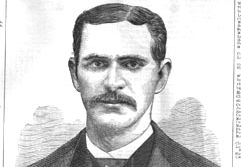
(Featured photo of Horace Phillips, as he was in 1884, from the New York Clipper)


 Fifth Avenue Sports
Leave a comment