
The Pittsburgh Burghers are no more.
A year after the revolutionary creation of the Players’ League in 1890, everyone was pretty much back to where they were.
The PL had the talent, they had the fans, and they had one of their main competitors, the American Association, on the ropes.
But the one thing they did not have was the money. And so, after their first season came to a close, concerns were running rampant within the PL about how the league could stay afloat. Their financial backers and new PL team owners would eventually sell out the players, causing the PL to fold and the striking teams and players to integrate back into their existing NL and AA counterparts.
In Pittsburgh, that meant the Burghers merged back into the Alleghenys franchise, but unlike in other baseball cities of the time, the reuniting of the two teams did actually lead to some changes.
The team moved ballparks, relocating to the newly built Exposition Park III, which was constructed for the Burghers before their one and only season in 1890. Having been so new, Exposition Park III provided a better experience for players and fans than the Alleghenys’ Recreation Park.
The organization also did an entire re-brand, some of it intentional and some of it accidental. The team dropped the Allegheny City (present-day North Side) banner and officially adopted Pittsburgh as their city name, and unofficially adopted the “Pirates” moniker after the Lou Bierbauer incident.
The merging process between PL and NL/AA franchises was messy, and in Philadelphia, the AA’s Athletics franchise had accidentally left Bierbauer, a standout second baseman, off their roster.
Noticing this, Alleghenys player-manager Ned Hanlon, who was a member of the rebelling Burghers in 1890, jumped at the chance to bring Bierbauer to Pittsburgh. Legend has it that Hanlon traveled to Bierbauer’s native Erie in the dead of winter to get the deal done.
When Philadelphia caught word of this, they objected to the Alleghenys’ move, saying that Bierbauer should have been able to return to Philadelphia after the PL folded. An AA league official called the act “piratical” and even though an independent arbitrator eventually sided with Pittsburgh’s claim that Bierbauer was a “free agent” and could sign where he wanted, the incident would eventually give the ballclub their permanent name.
Local newspapers caught onto the name within a few years, however the team did not acknowledge the nickname on their uniforms until 1912.
Bierbauer was a welcome addition to the team, but so were the return of defecting PL stars. The absence of stars like Jake Beckley, Pud Galvin, Hanlon, and others led to the Alleghenys suffering to a 23-113-2 record in 1890. That still stands as the worst season in Pirates’ franchise history.
The defecting players, meanwhile, had some unfinished business after an underwhelming 1890 campaign. The Burghers went 60-68 in the PL, finishing in sixth place.
The only notable player to not play again for the Alleghenys franchise after defecting to the Burghers was Bill Kuehne, a left side infielder who originally merged back with the club before being released on March 15th, about a month before the season.
The Pirates made several additions other than the returning Burghers players as well. Connie Mack, an eventual Hall of Fame manager, was brought in to help shore up the catching duties. Mack was one of the leaders of the PL rebellion, having invested $500 of his own money into the Buffalo Bisons in the league. Though never remarked as a heavy hitter, Mack would lead the NL in fielding percentage from behind the plate that year.
In the outfield, the team signed Dan Lally, whose baseball career spans over 10 leagues and 20 teams. His defensive work from the outfield was atrocious and his batting could not make up for it. He played sparingly during his only year in Pittsburgh.
On the mound, the team brought in a pair of pitchers, Mark Baldwin and Silver King, but their arrival in Pittsburgh was not without controversy. As the story goes, Baldwin, a Pittsburgh native, had a history of convincing his teammates to jump ship with him to other teams. Baldwin successfully helped nab several players for the PL the year prior, and after the league collapsed, Baldwin signed with Pittsburgh on March 1st, 1891.
Two days later, when Baldwin was in St. Louis, he successfully recruited King, who after the PL’s demise was the property of the AA’s St. Louis Browns, to sign in Pittsburgh as well.
When Browns owner Chris von der Ahe got word of this, he was outraged, and demanded the arrest of Baldwin on charges of conspiracy with Pittsburgh officials. Baldwin and von der Ahe had a history; Baldwin’s prior work of swiping players included convincing several of von der Ahe’s players to abandon the Browns for the PL.

On March 5th, Baldwin was in fact arrested at Laclede Hotel in St. Louis, charged with conspiring with Pittsburgh president J. Palmer O’Neill and manager Ned Hanlon to sign King, who von der Ahe insisted was under contract with the Browns.
The charges against Baldwin were eventually dropped, and both he and King were allowed to join the club in Pittsburgh. Baldwin and von der Ahe would sue each other for years afterwards, with Baldwin victorious. Three years later, in 1894, when von der Ahe visited Exposition Park III, he was arrested by a sheriff and thrown in jail. His bond was eventually paid by Pirates then-president William Nimick.
Had it not been for Bierbauer and Hanlon, Baldwin and King might be credited with giving the team the “Pirates” name.
Though the case was evntually dropped and King was allowed to leave St. Louis, his whereabouts were unknown for weeks afterwards. King did not appear in St. Louis for the team’s opener on April 8th, fueling speculation that he had in fact left for Pittsburgh.
But two weeks later, as the Pirates were opening their season, King was not there either, this time spreading rumors that he actually signed in Cincinnati. On April 27th, the Pittsburgh Dispatch ran the headline “The King Is Here,” and King had in fact come to town and signed with the team, inking a $5000 contract.
The team opened their 1891 season on April 22nd at home against the Chicago Colts (present-day Cubs), in front of a reported 5,500 fans. The Pirates lost that game 7-6 and would drop three of four against Chicago in their first series. They rebounded in their second series, swiping three of four from the Cleveland Spiders to close out the month.
They opened May on the road in Chicago, dropping two of three to the Colts and splitting a four-game series in Cincinnati against the Reds.
After that, the club returned to Pittsburgh for a lengthy 13-game home stand. They lost a 9-2 decision to the New York Giants to start, but rallied to win the next three and claim the series. That three-game run was their longest winning streak of the season until well into August.
On May 14th, the club released Phenomenal Smith, who appeared for the club and pitched in 44 innings for the Alleghenys in 1890. He had not played in a game for the team in 1891, and left to sign with his hometown team in Philadelphia.
Two weeks later, on the 27th, the club would also release Harry Staley, who had pitched 71.2 innings with a 2.89 ERA. Staley had fallen out of favor with team management, and after negotiations to faciliate a trade fell through, the Pirates simply released him. He signed in Boston the same day, to much fanfare.
The Pirates went 8-5 but ending their time in Pittsburgh with a series loss to Boston, who would prove to be an awful matchup for the Pirates.
A 6-1 loss to Boston sent them on a disastrous 16-game road trip that spanned the final few days of May and the first half of June. The Pirates lost three straight series against Brooklyn, Philadelphia, and New York before getting swept by Boston, plummeting the Pirates to an 18-25 record by the time they returned home.
The Pirates won their only series back at Exposition Park III before another road trip that saw them be swept by Cleveland, but win back-to-back series against Chicago and Cincinnati.
The Pirates returned home on July 4th, playing a double-header against Boston. Over 5,000 fans attended the first game and over 6,200 attended the second, both one-score losses. The third game of that series, played on the 6th, would see Boston sweep Pittsburgh again.
July saw some more personnel changes for the Pirates. On July 8th, the team bought some batting support, purchasing Frank Shugart from the Minneapolis Millers in the Western Association for an unknown amount. Shugart, who was batting .336 with the Millers at the time of the deal, had previously played in the major leagues for Chicago in 1890.
Shugart would take over the shortstop responsibilities for Pittsburgh, and while he hit a decent .275 on the year, he was very poor defensively. He committed 44 errors and in 1892 would lead the NL in errors.
Five days later, Jocko Fields was released. He had been the primary shortstop for the Pirates that year, hitting .240. The reasons for his release depended on your source. Reports claim that Fields claimed he injured his hand after a wrestling match with his teammate Baldwin, but that he actually injured it getting too close to a dog fight. Regardless of what the true reason was, Pittsburgh media was happy to see him go.
On the 22nd, the team sent $500 to Portland of the New England League for the services of John Newell. The infielder would only play five games for the Pirates, going 2-for-19 at the plate. Though he played until 1899, his brief stint with Pittsburgh was his only major league experience.
The changes failed to bring any immediate impact to the Pirates, who struggled through July despite 20 of their 26 games that month being at home. They went 10-16 during the month, and although they played some good ball, two different five-game losing streaks killed any progress they could have made in the standings.
On July 30th, with the Pirates standing at 31-47, Hanlon was demoted from his spot as the team’s manager, and the club brought in Bill McGunnigle to replace him. Despite having only a few years of experience managing, McGunnigle was a winner. He led the Brooklyn Bridegrooms to an AA pennant in 1889 and an NL pennant in 1890, with the 1890 club reaching a World Series tie with the Louisville Colonels.
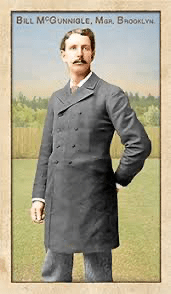
His first game as manager would see the Pirates lose a 6-5 matchup against Cleveland, though he earned his first win the next day.
The Pirates entered August 15 games under .500 and 17 games back of the league lead. They went 3-3 to start the month, but suffered a ten-game losing streak that killed any remaining hopes they had.
Ironically, the Pirates would go on to win eight of their next nine, including miraculously taking a series against Boston near the end of the month.
On August 25th, the Pirates released Newell, as well as Fred Carroll, who had played primarily right field for the team. Carroll, a career .284 batter in the big leagues, was struggling to a .218 average. Though he played baseball for several more years, he too would never get back in major league action.
The Pirates had found some late-season momentum in the first half of September, with the team going 11-4. A five game winning streak was halted by a 7-7 tie to Boston on September 17th, and I suppose that Boston wasn’t too keen on tying the Pirates, because they beat them in three consecutive games after that by a combined score of 31-8.
On September 23rd, the club released King, a two-time ERA Title winner. After the effort to get him to town, he was rather unlucky with the Pirates, finishing the year with a league-leading 29 losses.
That same day, the team would record their final home win, a 12-3 blowout of Cleveland in front of 1,348 fans.
Two days later, the Pirates unsuccessfully protested a win awarded to Chicago by umpire James McQuade. Per Retrosheet, the game was called with two out in the eighth inning. Chicago, the home team, had just scored a pair of runs to tie the game at 4-4, with Pittsburgh utility man George Miller (in some sources, he is named Doggie Miller) objected to a call made by McQuade.
As Miller was letting McQuade hear it, he was tossed from the game, but manager McGunnigle refused to replace Miller with someone else, leading to Pittsburgh being forced to forfeit the game.
The next day, these two teams would tie.
On the 27th, the team released third baseman Charlie Reilly, who had come over from the AA Colorado and was a regular in the Pittsburgh lineup, but batted an underwhelming .219.
The Pirates would drop their last three home games, all to Cincinnati, and be swept on the road in Cleveland to end their miserable year at 55-80-2. They finished last in the NL, 30.5 games back of first-place Boston.
Boston was an unbelievably bad matchup for the Pirates that year, with Pittsburgh going 3-18-1 against them.
Despite their terrible record, the Pirates did boast winning records over New York and Brooklyn that year, and they were a respectable 32-34 at home over the year.
First baseman Jake Beckley led the team with a .292 average, but he had fierce competition from outfielder Pete Browning, who was one tick behind at .291. Beckley would also lead the team with 73 RBI, but Browning would take the team’s lead in OPS, at .805, and both would place in a four-way tie with four homers.

George Miller, who played a team-leading 135 games, would also record the most walks, at 59.
Pittsburgh was at or near the bottom in virtually every offensive statistic. They batted .239 as a team, and the only categories where they were above league average were hit by pitch and strikeouts.
Bierbauer, the man responsible for the team garnering the “Pirates” name, didn’t live up to the hype in 1891. His .206 average and .514 OPS were both career-worsts for Bierbauer, and although his follow up years with Pittsburgh would greatly improve, his first year with the team was rather underwhelming.
On the mound, Baldwin posted a 2.76 ERA, tying the best mark of his big league career. He did that while frequently bickering with Pittsburgh press, who he formed quite a contentious relationship with. He pitched 437.2 innings.
At one point during a moment of frustration during the year, he demanded to be released. Hanlon, who was still the manager then, refused and played him more often, which is exactly the kind of pettiness I think we can all get behind.
The aforementioned King, who had been released before the year was over, tossed nearly 400 innings to a 3.11 ERA.
The team’s pitching staff actually stacked up very well against the rest of the league. Their combined 2.89 ERA ranked second in the NL behind Boston.
Six players played less than ten games for the team in 1891, including Scott Stratton, who won the ERA Title in the AA the year prior. He threw just 18.1 innings for Pittsburgh, surrendering five earned runs.
The Pirates lost or released many players during the season, but Browning’s departure was perhaps the hardest to take. The three-time batting champ is referred to as one of the game’s pre-modern stars. He split the season between Pittsburgh and Cincinnati in 1891, but the date for which he left Pittsburgh is unclear.
Browning’s career and later life is fascinating, and I would encourage you to read about it. His baseball days ended in 1894, but a series of health issues cut his life short, dying at age 44. His final few years were hectic, with a court finding him a “lunatic” and ordering him into the Fourth Kentucky Lunatic Asylum.
He was rescued from the asylum by his sister, but health complications soon piled up, and Browning spent much of his final months in University Hospital, where he died in September of 1905. His place of death has been recently corrected, with original writings stating he died while a patient in the asylum.
Here is a look at the full 1891 roster:

(Featured photo is of Exposition Park III, circa 1903 and colorized)

 Fifth Avenue Sports
Leave a comment