
Baseball was in a tense place in the late 1880s.
The older National League and the upstart American Association had been competing for eyes, money, and players ever since the latter was formed in 1882. Though the more established NL had the long-term upper hand, the AA remained a thorn in the side of the NL over the years.
But within the NL itself, a nastier feud was emerging. Players were up in arms over a series of moves by the league, starting with the infamous reverse clause that was first implemented in 1879.
The reserve clause, in essence, ensured that a team was entitled to reserve the services of a player in perpetuity. When a player’s contract expired, his team had the exclusive right to negotiate with him for a new contract. This move, which at first restricted teams to “reserving” just five players, kept salaries artificially low and did not allow players to test the market for their services.
Their complaints fell on deaf ears, and in 1887, the NL expanded the reserve clause to reach team’s entire rosters. As has been the case since the dawn of sports leagues, players weren’t taking all that kindly to owners limiting their rights.
In addition to the reserve rule, the NL (along with the AA) instituted a $2,000 salary limit on players, which is a little under $59,000 today. Two years later, after backlash, team owners agreed to remove the salary limit, but replaced it with the equally unpopular and equally restrictive “classification system,” which set players’ salaries based on their classification on a scale from A to E, essentially re-creating salary limits.
Frustrated with the reserve clause, as well as salary limits imposed by the league, John Montgomery Ward, then of the NL’s New York Giants, formed the Brotherhood of Professional Base Ball Players, a very early version of the MLBPA in 1885.
A Columbia Law School graduate, Ward was joined by a sizable chunk of the NL’s playing populous at the time, voicing their concerns about the owners’ power over the league.
Despite their objections, things only worsened between the league and the union, and on November 4th, 1889, after the conclusion of the season, the Brotherhood declared their intentions to leave the league and form their own. A month and a half later on December 16th, 1889, they did just that.
Officially known as the Players’ National League of Professional Base Ball Clubs, the league was commonly known as the Players’ League. Ward was very influential in assuring that the idea rose from a threat to an entity.
The league, which was created with profit sharing system for the players and had no reserve clause or classification system, launched eight initial teams:
- Boston Reds
- Brooklyn Ward’s Wonders (named after the Brotherhood’s founder)
- Buffalo Bisons
- Chicago Pirates
- Cleveland Infants
- New York Giants
- Philadelphia Athletics
- Pittsburgh Burghers
Over half of the National League’s total player pool jumped to the Players’ League in a revolt against the NL. Many PL teams were formed in cities that already had established NL teams, leading to a majority of defecting players signing with the PL team formed in their current city.
Pittsburgh’s foray into the PL brought a second pro baseball team into western Pennsylvania. Allegheny City, known informally as the Alleghenys, had been playing in the area since 1882, having been a founding member of the AA. In 1887, they jumped to the NL.
With the Brotherhood being comprised of the star and upper-tier players in the NL at the time, nearly every NL team suffered significant roster losses as a result of the PL.
The Alleghenys were particularly gutted by their revolutionary new neighbors in the Burghers. In addition to future Hall of Famers Pud Galvin, Ned Hanlon, and Jake Beckley, the team also utility man Jocko Fields, two-way player Al Maul, and Fred Carroll, who led the NL in 1889 with a .486 on-base percentage and a .970 OPS.
In addition to purging the Alleghenys of talent, the Burghers were also able to nab pitcher John Tener, who jumped from the NL’s Chicago Colts, as well as AA defectors William Robinson (from St. Louis) and Joe Visner (from AA Brooklyn). Visner was a relatively unknown player at the time, but would prove very effective for the Burghers.
The Alleghenys, meanwhile, were left for dead in the NL. Forced to pick up the pieces of the PL’s pillage, the Alleghenys cycled through dozens of players, doing whatever they could to simply field a team. Despite their efforts, the 1890 Allegheny City club ended up putting together one of the worst seasons in the history of organized baseball.
The Alleghenys’ horrid performance led to them playing a vast majority of their games out of town, leaving the Burghers as the main team in town to watch.
Despite playing under the Pittsburgh banner, the team’s home ballpark was on the other side of the river in Allegheny City, then considered a separate town that was not annexed into the city of Pittsburgh until 1907.
Suddenly in need of a ballpark for their team, new Burghers owners John Beemer and M. B. Lennon were able to reconfigure the former racetrack into a field in time for the 1890 PL season.
Their new home, Exposition Park III, was constructed near its predecessors, Exposition Parks I and II, and included a roofed wooden grandstand around the infield and open bleacher sections extending to the right and left field corners. Total capacity was around 10,000.
Unfortunately for the Burghers, their new home faced similar problems that previous ballparks in the area did. Fire concerns to the wooden structure were of constant concern, and flooding from the nearby Allegheny River was constant. It was not uncommon for the outfield to be several feet high in water during games.
The conditions at the park led to a quip from the Pittsburgh Daily Post: “They have the most level grounds in the country. Exposition Park is covered with water.”
Outfielder Ned Hanlon was tabbed as the team’s player-manager. After the Alleghenys dismissed longtime manager Horace Phillips midway through the 1889 season, the team first turned to Fred Dunlap, who managed 17 games before the responsibilities were turned over to Hanlon.
The Burghers opened their ten games of the season alternating between wins and losses. That streak finally broke on May 5th, when the Burghers beat the Chicago Pirates to string together a two-game streak and put them at 6-5.
Two weeks later, though, the Burghers suffered a nine-game losing streak, including sweeps in Boston and Brooklyn to plummet them all the way down to 8-17. It was their longest losing streak of the season, and it created a hole that the team would spend months trying to fully dig themselves out of.
The Burghers couldn’t wait for May to be over, and before they escaped its clutches, the team suffered a 23-3 shellacking in New York on the 31st. It was their worst loss of the season.
Luckily for the Burghers, their fortunes changed as the calendar did. They opened the month with series wins in Buffalo and Chicago, the latter of of which would spark two different five-game winning streaks for the Burghers in the month. Those streaks helped drag the team all the way back to 500, getting over that benchmark on June 19th and hovering around that figure for weeks.
Also in June, Pittsburgh’s Jocko Fields hit the first ever home run in Exposition Park III on June 10th, in a game the Burghers won 10-4.
Their turnaround, along with the improving weather, lead to some additional attendance at their games. July saw the team record their highest reported attendance, splitting an Independence Day double-header at home with Brooklyn in front of 9,489 fans.
Five days later, the team racked up their biggest win of the season, routing the Philadelphia Athletics 16-0 at Forepaugh Park.
However, July brought hardship as well. July 10th through the 12th saw the Burghers get swept in Boston, dropping them back below .500. However, all three games were later ruled as “no decision” by the PL, after it was determined that Boston used Gil Hatfield, who was on loan from new York, against league rules. Therefore, Boston’s series win was voided.
The Hatfield debacle served unofficial turning point for the Burghers. That series kicked off a nine game stretch where the Burghers were on the short end of the score, even though the three games in Boston were voided and officially considered as ties in the standings.
In all, the team lost 12 out of 15 to end the month after the Boston series, and ended July with a measly 8-14 record. July 14th marked the final day the Burghers would be above .500 during the 1890 season.
Unlike their last major skid, the Burghers could not find their footing again. Pittsburgh fared no better in August, going 9-16. They lost nine of 11 to close out the month.
The Burghers went 9-3 in the first half of September, but by that point the team was far enough behind in the standings for it to matter. They finished the season with 12 home games, going 7-5 and sweeping Philadelphia over the home stretch. A 7-3 loss to Boston, the second game of a double header, marked the end of Pittsburgh’s season on October 4th.
The Burghers finished the season at 60-68-3, good for sixth place in the PL and 20.5 games back of the league lead. Despite the disappointing finish, it was miles ahead of whatever the hell they were doing over at Recreation Park, where the Alleghenys had finished a staggering 23-113-2.
Jake Beckley finished the season as the team’s batting leader, hitting .323 with a team-leading 123 RBI. Beckley was tied for the team lead in home runs, hitting 9 along with Jocko Fields, and was also tied for the league lead in triples, racking up 22 alongside Burghers teammade Joe Visner.
Second baseman William Robinson finished second in the league in walks, drawing 104 of them in 429 plate appearances.
Fields also had a solid season, hitting .282 and tallying 19 doubles, 20 triples, and 9 home runs.
Ned Hanlon, in addition to his managerial duties for the Burghers, snagged a team-leading 65 stolen bases.
While the stars of the Burghers did their thing, the team overall failed to produce in a Players League that was very hitter-friendly. As a team, the Burghers finished last in with a .259 batting average, 15 ticks below the .274 league average.
Except for triples, where the Burghers led the league by the narrowest of margins, they were under league average in every batting category.
In the pitching department, Harry Staley led the team with a 3.23 ERA and led the entire league with a 1.213 WHIP and 1.95 K/BB ratio. He was one of five total pitchers in the PL to have have a positive strikeout to walk ratio.
Al Maul was the only Burghers pitcher to finish with a winning record, going 16-12 on the year. Maul also put together a decent season at the plate, hitting .259 and being the only Burghers arm to hit above .208.
The Burghers’ combined 4.27 ERA was just barely bad enough for the second worst mark in the league. However, team ERAs were pretty logjammed in the PL, with .32 runs making the difference between third place and seventh.
Pittsburgh’s pitching staff finished atop the league in WHIP and K/BB ratio, but with the team allowing 7.11 runs per game, wins were hard to come by. Pittsburgh’s 2.84 difference between pitcher ERA and total runs allowed per game were the second highest in the PL.
The Burghers served as the launching point shortstop Tommy Corcoran’s career. The 1890 PL season marked Corcoran’s first big league season, and the Tommy the Cork would go on to play nearly two decades in the NL after the merger, none of them for Pittsburgh.
The Burghers were a unique group, and while overall they fell short of expectations, they did take on the mantle of being the city’s true baseball team that season. Their home record was a solid 37–28.
Here’s a look at the team’s complete roster:
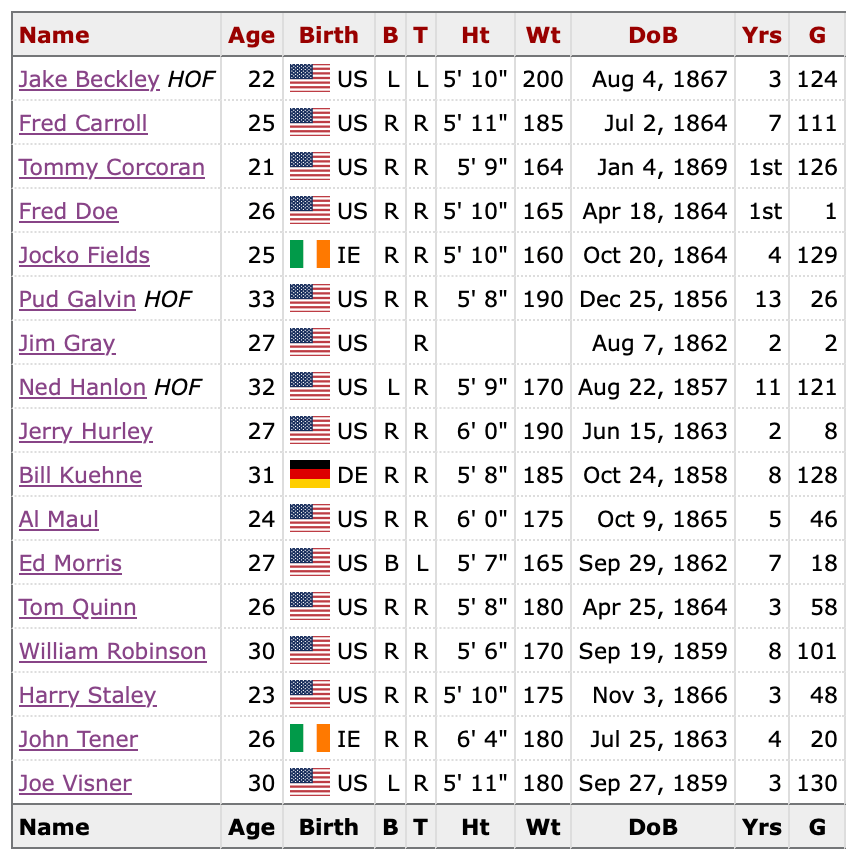
Boston would go on to win the only ever PL, finishing the season 81-48-4. The Players League outdrew both the NL and AA, having the best attendance numbers of all three leagues. In Pittsburgh, the PL Burghers outdrew the NL Alleghenys by a final total of 117,123 to 16,064.
Brooklyn was the only head-to-head market where the NL team came out ahead. The NL’s Brooklyn Bridegrooms would go on to win a pennant in 1890, which contributed to their success fending off the Wonders.
Even the AA had outdrawn the NL in 1890, but was still a distant third in markets that featured teams of all three leagues.
Unfortunately for the players, the PL was ultimately destroyed from within. The league was owned and operated by a combination of owners, who served as financial backers, and elected player representatives.
The PL’s financial backers were antsy to see a profit in their new league, but the 1890 season came and went without one. Despite the PL’s success in attendance numbers, the league struggled to turn a profit in its first year, thanks in part to the league’s revenue sharing plan with its players. Nearly every team lost money at year’s end.
Seeing this, many leaders and backers of the PL lost faith in the project, and some looked for a way out.
In the end, the PL lacked the long-term financial capacity or knowledge on how to truly start a league, even while holding the advantage in the baseball talent level. The NL, meanwhile, did have the fortitude to manage this turbulent time in the sport, and were far more confident in their financial abilities than the PL was.
In the league’s final months, elected representatives were locked out of meetings and operations. In January of 1891, the faithless owners of the New York Giants and Brooklyn Wonders went behind the back of John Montgomery Ward and the players, negotiating a deal to fold their franchises back into the NL. On the 16th, the league officially collapsed.
The PL’s long-term goals of pushing the NL to change their ways had failed. The reserve clause would stay in place for decades. The PL also had the unintended consequence of eventually killing off the AA, which would fold after the 1891 season. The AA’s death consolidated the viable leagues in the nation and giving owners more power over less players.
However, Ward and the Brotherhood’s efforts were not entirely in vain. They were influential in getting the NL to drop the classification system, and many of the new and improved ballparks and facilities that were constructed for PL use were eventually used by NL teams.
As was the case in Pittsburgh. When the Burghers merged with their NL couterparts (as several PL teams did), the team decided to use Exposition Park III, the park built for the Burghers, as their new home moving forward. The team would remain there until 1909, when the team moved away from the river to Forbes Field.
Officially, the Burghers were absorbed by the Alleghenys, bringing the defecting PL players back into the NL. Coming back to the NL franchise were Ned Hanlon, Jake Beckley, Fred Carroll, Jocko Fields, Pud Galvin, Al Maul, and Harry Staley.
Not every ex-Allegheny made it to the 1891 season with the club, however. Third baseban Bill Kuehne, who played for Allegheny City for five years before the revolt, initially came back to the team after the merger, but was released before the season started. He would play for five teams over the next two years before calling it quits.
Additionally, AA defectors Joe Visner and William Robinson also returned to that league after the PL’s collapse.
The 1891 season was the first official year the organization were known as “Pittsburgh” in the NL, and although they still played without an official name, they would soon adopt “Pirates” as the team name, after they were accused of “pirating” second baseman Lou Bierbauer from the Philadelphia Athletics of the AA after he was inadvertently left off their new roster after the PL merger.
Featured photo of Exposition Park III, in 1915, from Wikipedia/Pittsburgh City Photographer)


 Fifth Avenue Sports
Leave a comment