Call-ups, demotions, and roster shuffling can happen in the blink of an idea in present-day Major League Baseball. It’s both a beauty and a curse of the sport.
One day, you can be receiving that life-changing call that the dream you’ve spent your whole life working towards is finally happening. Then, you can find yourself demoted right back down to the minor leagues. One day you’re a big leaguer, the next day you’re not.
With how fast-paced roster decisions are today, it’s almost astounding to think that an MLB club could be so far away from their top minor league affiliate. When the Pirates affiliated with the Hawaii Islanders starting in 1983, their Triple-A guys, including top prospects, were playing half their games over 4,600 miles away.
Imagine if this season, Konnor Griffin opened the season in Triple-A Hawaii. When the Pirates called him up on April 2nd after just five games in the minor leagues, he was on the field at PNC Park the next day to make his MLB debut. Had he been forced to travel from Honolulu, the travel time alone would have likely postponed his debut by a day.
Griffin, or any other prospect from that time, would have still been just “a phone call away,” but the logistics for having a top farm club all the way out in the Pacific Ocean made it a much more convoluted endeavor.
But, despite the complicated travel schedule, the existence and acceptance of Honolulu as an affiliate had already been commonplace around the league for over 20 years. In fact, they weren’t even the farthest affiliation by distance the Islanders had taken.
Though the majority of Hawaii’s partnerships were with west-coast teams in the mainland United States, the Islanders did have a brief link to the Washington Senators from 1965 until 1967. Assuming the Senators were home, a call-up would have travelled 4,837 miles to a place six hours ahead.
By the time the Pirates had washed ashore on the islands of Hawaii, they were already the seventh organization to team up with the Islanders and send some of their top prospects and best fringe-leaguers into the Pacific.
Following their relocation from Sacramento and rebrand from the Solons to the Islanders, Hawaii made their Pacific Coast League debut in 1961, playing out of the historic, albeit old and slightly run-down, Honolulu Stadium. In the years to come, the ballpark would be named the “Termite Palace” for the pest problem it would suffer.
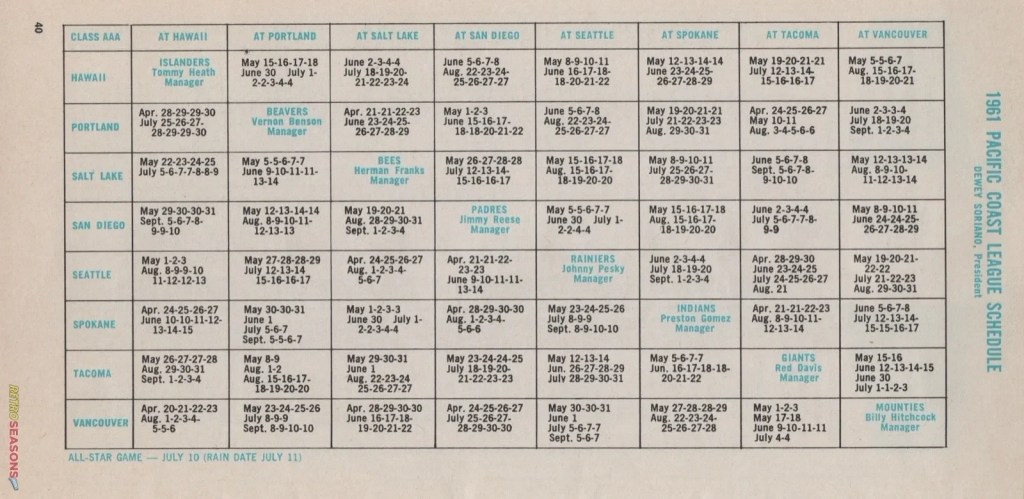
A team located in Hawaii meant changes to the PCL scheduling. The seven other PCL teams made two trips to the islands each year, and one of those trips would involve an eight-game series against the Islanders to minimize travel time and expenses.
Their move to Hawaii also came with a new affiliation. When the Islanders took the field, they would serve as the PCL and Triple-A affiliate of the Athletics (who were in the middle of a 12-year stay in Kansas City from Philadelphia, en route to Oakland).
With Tommy Heath managing to open the year, the Islanders went 68-86 in their inaugural season. Forty-year-old Bill Werle, who threw nearly 600 innings for the Pirates between 1949 and 1952, served as Hawaii’s pitching coach but also took the mound 22 times for the Islanders. After Heath was kicked upstairs to a front office job in August, Werle took over as manager.
The affiliation with the Athletics only lasted one year, and the Islanders would serve as the Triple-A club for five different MLB organizations in their first decade. Their early history also included a sale just a few years into their time on the island; Nick Morgan Jr., who bought the team back in 1961, sold the Islanders to a local group that included state senator Sakae Takahashi.
One of their peaks came in 1970, when in front of a league-leading 467,217 fans, the Islanders set a franchise-best record of 98-48, topping the PCL and punching their ticket to the final. That team was managed by Chuck Tanner, eventual manager of the Pittsburgh Pirates and winner of the 1979 World Series.
But that run was quickly put down once they met the Spokane Indians, who swept them 4-0 and outscored Hawaii a stunning 36-0.
The following year, the Islanders finally secured a stable relationship with a parent club, kicking off an eventual 11-year affiliation with San Diego, which really allowed the Hawaii to thrive on the field.
Under the Padres, the Islanders operated almost like an independent club within the PCL. During the early years of their affiliation, San Diego only sent a handful of players down to Hawaii, allowing the Islanders to fill out the rest of their roster with the best talent and free agents available in minor league ball.
As a result, Hawaii was able to field some pretty competitive clubs. Though a subpar batting department had dragged their pitching down in the early 1970s, the Islanders had finally found the right mix in 1975.
No game better exemplified that than a May 19th “travesty” that took place on a cold, rain-soaked, windy night in the team’s final year at Honolulu Stadium. Two rosters stocked with past and future MLB talent met in front of just 150 fans, and the hometown Islanders steamrolled the Salt Lake City Gulls 19-0.
Islanders righty Gary Ross, who had six years and over 400 innings of big leagu experience as primarily a reliever, threw a perfect game for Hawaii. But remarkably, that ran as a side show to a 15-run first inning for the Islanders, who trotted out 20 to the plate, five more batters than the Gulls would send all game.
Lost in the throttling of the Gulls was the race against time. The harsh weather conditions that night gave the two teams supposedly very different strategies later on; Hawaii accused Salt Lake City of stalling, in the hopes officials would call the game before it could go down in the books. The Gulls shot back with the belief that Islanders players, after the first inning, purposely swinging and missing and opting not to run out hits in order to push the game past that five-inning threshold.
Those two teams would meet again in the 1975 PCL Finals, where Hawaii won the series 4-2 to claim their first-ever PCL title.
The following season, the Islanders set out to defend their title while also celebrating a new home. Honolulu Stadium had bit the Islanders farewell, and Hawaii had moved into the newly built Aloha Stadium in nearby Hālawa.
Aloha Stadium would eventually prove fatal to the Islanders’ existence, as their new home in a western suburb of Honolulu took the team away from their primary fan base. In addition, many fans had used the city’s public transportation to get to Honolulu Stadium; Aloha Stadium, by comparison, was far less accessible.
The move had on-field implications, as well. The new ballpark’s manager, Mackay Yanagisawa (known as the “Shogun of Sports”) prevented the use of metal spikes in players’ cleats, which caused more wear and tear on the taxpayer-funded Astroturf. The stadium’s first few visitors had no complains about the rule, but the spike issue arose when the Tacoma Twins arrived in Honolulu.
Adhering to an organizational rule requiring all pitchers to wear spikes, Tacoma starter Bill Butler was indeed sporting metal cleats on May 7th as the Twins took on the Islanders. While he was walking to the mound, stadium security marched out to inspect his shoes. Once they verified Butler’s shoes broke Aloha Stadium protocol, one of the officials made a hand signal to the press box. Within seconds, the lights were shut off.
At 7:47pm that night, an announcement went out explaining that Butler’s shoes broke ballpark policy, and that Tacoma would have to adhere to the no-metal rule before the game could continue. The ballpark would give the Twins until 8:10pm to comply.
The umpires, meanwhile, gave the Islanders 15 minutes to restore the lighting to the park. Amidst the wait, a barefoot fan had hoped the stands and ran the bases. Eventually, time had expired, and the umpires awarded Tacoma the win via forfeit. The 5,000 fans, many of whom had arrived to celebrate the team’s 25-cent beer promotion that night, booed as the home team was handed a forfeited loss.
Hawaii protested, but the PCL sided with Tacoma. Further chapters in that saga included Hawaii’s governor George Ariyoshi allowing quarter-inch spikes, before the Astroturf company said half-inch spikes could be used without major damage to the field.
That forfeited game wound up making a world of difference at the end of the year. The Twins suffered a loss on the final day of the regular season, while the Islanders won, tying their records at season’s end and forcing a one-game tiebreaker, which Hawaii won.
The Islanders then advanced to the final for a rematch with Salt Lake City. Following their 7-4 game one win over the Gulls, the PCL announced the planned expulsion of Hawaii from the league, citing outstanding bills to both the league and other clubs. Though the PCL wouldn’t kick the Islanders out before the finals were over, the financial constraints did result in the league seven-game series to five games, and the entire series was played in Utah. Hawaii won 3-2.
A new general manager and increased fan promotions helped lift the Islanders out of immediate financial ruin, granting them their franchise back and keeping the on-field product exciting.
Hawaii nearly made the three-peat come true in 1977, when the Islanders rode a 79-67 season back to the final before falling to the Phoenix Giants. Finals losses would become a bit of a trend for the Islanders, who also fell in the PCL championship series to Salt Lake City in 1979 and Albuquerque in 1980.
Two years later, their successful partnership with the Padres had come to an end. The Pirates then came ashore, announcing a new affiliation with Hawaii starting with the 1983 season. And while the heyday of Islanders baseball had perhaps passed, and the team was still dealing with lingering financial problems, Pittsburgh’s time with the islands did provide some interesting years.


Leave a comment