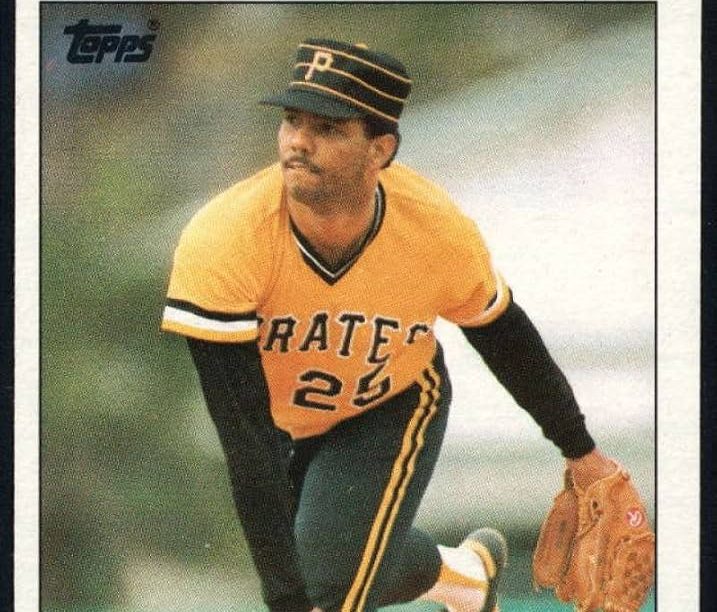
One year after celebrating their centennial anniversary as a franchise, the Pittsburgh Pirates officially began their partnership with the Hawaii Islanders.
Still managed by Tom Trebelhorn, the Pirates had shifted most of their Triple-A talent from the Portland Beavers, their previous affiliate. Over a dozen players who suited up for Portland in 1982 found themselves playing ball on the islands the following year, including an eventual major leaguer in Trench Davis, who led the Beavers with 141 games played.
José DeLeón, who threw 119 innings for Portland in 1982, would top that number with 127.1 innings for Hawaii the following year. He was one of the team’s best arms for the Islanders that season.
Stashing most of their best minor league talent in Honolulu, the Islanders fought and battled all season to stay above the .500 line. In the end, Hawaii finished just one game over at 72-71, good for third in the Pacific Coast League’s South Division and fifth in the entire ten-team league. It was the fourth straight winning season for the Islanders as a franchise, albeit by the thinnest of margins.
Batting really dragged down the Islanders in 1983. As a team, Hawaii slashed .271/.336/.410 for a .747 OPS.
First baseman Eddie Vargas led the Islanders in most batting categories. The 24-year-old slashed 348/.392/.618 (1.010 OPS) with 12 home runs and 46 RBI for Hawaii. Vargas made his MLB debut the season prior, playing eight games at the tail end of the 1982 season for the Pirates, going 3-for-8 with a trio of RBI.
Unfortunately for the Islanders, they didn’t get very much playing time out of Vargas. He only played 53 games for the team, also playing 20 games for Pittsburgh’s Double-A affiliate in Lynn.
Helping lead in the absence of Vargas was a fellow 24-year-old in Doug Frobel, who slashed .304/.374/.574 (.948 OPS) while drilling 24 home runs and 80 RBI. The outfielder had twice as many homers as the next Islander, and had he played just a few more games, would have snagged the RBI lead as well.
The Ottawa native was called up by the Pirates in mid-August of that year. After a 16-game stint with the Pirates in 1982, Frobel put by his best numbers by far as a major leaguer. In 32 games at the end of the season, slashing .283/.328/.533 (.861 OPS) in 64 plate appearances. Unfortunately for Frobel, strikeouts plagued the 268-game MLB career he would produce.
The only other batter to record an OPS above the league average was Ron Wotus. A middle infielder and one of seven Islanders to play 100+ games for Hawaii, Wotus slashed .301/.379/.452 (.831 OPS) with ten home runs and 62 RBI in 125 games. Wotus would make his major league debut in September, playing five games for the Pirates and 27 the following year.
The Pacific Coast League has historically been a hitter-friendly league, and that was certainly true in 1983. The league average slash line was .286/.363/.446 for an .809 OPS.
But Hawaii didn’t get that memo. The Islanders were dead-last in runs per game, walks drawn, on-base percentage, and OPS. Their dreadful batting performance unfortunately negated a great pitching staff the Islanders rostered that year.
Hawaiian pitching combined for a 4.28 ERA, which looks somewhat pedestrian by today’s standards but led the PCL that season. See what I mean about a hitter-friendly league?
The Islanders also finished with the second-best team WHIP at 1.496, allowed the fewest hits, fewest home runs, and led the PCL with nine shutouts. The aforementioned DeLeón pitched to a 3.04 ERA, 1.241 WHIP, and 1.88 strikeout-to-walk ratio.
That success led to a promotion to Pittsburgh in July, where in his rookie season he bested even his Triple-A numbers with a 2.83 ERA, 1.130 WHIP, and 2.51 strikeout-to-walk ratio. He finished seventh in Rookie of the Year voting, perhaps he could have given Darryl Strawberry a run for his money.
But even after DeLeón left, Hawaii’s pitching was still in good hands. Bob Owchinko, the oldest starter in the rotation, threw a 4.25 ERA, 1.496 WHIP, and 2.21 strikeout-to-walk ratio.
A six-year big-league veteran by the time he wore an Islanders uniform, Owchinko was in Hawaii looking to rebound after a harsh 1982 campaign but his MLB career on hold. Owchinko would get back into a big-league groove in 1984 in Cincinnati.
The bullpen, meanwhile, was led by Don Stanhouse. At 32, the righty had pitched nine major league seasons but tumbled out of MLB. After pitching on the losing end of the 1979 World Series (to the Pirates), and was ineffective as a reliever for Los Angeles the next year.
The Dodgers iced him for the entire 1981 season, and after a brief stint back with Baltimore the next year, his final baseball season came with the Islanders. Stanhouse accounted for a 3.15 ERA and 1.383 WHIP, although he threw more walks than strikeouts.
Stanhouse split the closer’s role with Ray Krawczyk, who pitched sporadically for the Pirates from 1984 to 1986. Though he struggled in the bigs, Krawczyk pitched to a 3.76 ERA, 1.274 WHIP, and 2.67 strikeout-to-walk ratio as a righty.
Though Hawaii was a middling team in 1983, they would go on to find great success the next year.


Leave a comment