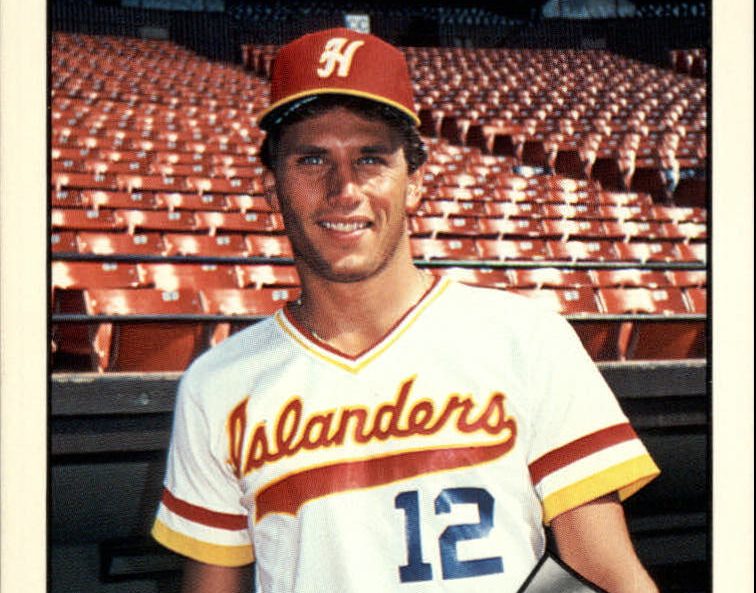
After a middling 1983 season where the Islanders go 72-71, Hawaii made some changes before swinging back into the 1984 season.
Tom Trebelhorn was out as manager, taking the year off after two seasons managing minor league affiliates of the Pittsburgh Pirates. Stepping into his place was Tommy Sandt, manager of the organization’s Double-A affiliate in Lynn the season before, and in Buffalo before that.
Sandt, who had played 157 games for Triple-A Portland from 1979 to 1981 when they were a Pirate affiliate, had made the jump to a managerial career in 1982. After a year in Buffalo, Sandt took over as Pittsburgh moved their Double-A affiliation up north to Lynn and even played in a handful of games that year, while still managing the club.
By 1984, he was ready for a Triple-A job, and he was inheriting an Islanders pitching staff with some serious talent. On the mound, Hawaii boasted a blend of exciting young prospects and more established veterans looking to get (or get back) to the major leagues.
Heading up Hawaii’s rotation was Alfonso Pulido, a highly sought after talent who the Pirates were able to pick up late into the 1983 season. Pitching for years in his native Mexico, the skilled lefty was coming off his best season yet in the Mexican League. He made his major league debut for Pittsburgh later that season, but needed some seasoning in Triple-A for 1984.
With the Islanders, Pulido pitched to a stellar 18-6 record with a 2.54, 1.093 WHIP, and 2.67 strikeout-to-walk ratio.
Aiding Pulido in the rotation was Mike Bielecki, a right-hander and former eighth overall pick by the Pirates in 1979. Bielecki had followed Sandt from Lynn down to Honolulu, and while on the island he provided Hawaii with a reliable arm and a 2.97 ERA. Bielecki further contributed by leading the team with 162 strikeouts.
Among the more experienced members was a future longtime Pirate Bob Walk. After making his MLB debut in Philadelphia and pitching three seasons with the Atlanta Braves, Walk had tumbled out of the bigs by 1983.
A rough 1982 campaign put him mostly in Triple-A Richmond the following year, and eventually led to his release after spring training in 1984. A week later, the Pirates signed him to a minor league deal and flew him to Hawaii in time for the Islanders to start their season.
Hawaii really helped Walk revitalize his career. He made two spot starts for the Pirates in July of 1984, but used his full body of work with the Islanders in 1984 and 1985 to propel him back into a full-time MLB job.
The bullpen was just as strong. Led by 24-year-old Ray Krawczyk, Hawaii’s closer improved on last season’s marks and put up a 2.13 ERA, 1.292 WHIP, and 2.14 strikeout-to-walk ratio. His success earned him a brief fill-in promotion for the Pirates midway through the year, and was the start of parts of five seasons he would pitch in the majors.
Jeff Zaske also took care of business when he needed to. The right-hander accounted for a 3.58 ERA, 1.508 WHIP, and 1.50 strikeout-to-walk ratio, and like other arms in Honolulu got a quick call to Pittsburgh. Zaske made his major league debut in July and threw five scoreless innings before returning to Hawaii. He never made it back to the bigs, but can always boast a blank ERA in baseball’s highest level.
The only pitcher north of 30 to throw for Hawaii that year was lefty Dave Tomlin, who provided a veteran presence on the back end for the Islanders. Though his major league days were almost done, he still had plenty in the tank for a few runs in Triple-A. For Hawaii in 1984, he pitched to a 2.66 ERA, 1.303 WHIP, and 2.05 strikeout-to-walk ratio.
And given how much the Islanders struggled on offense, Hawaii needed all the help they could get from their pitching staff. Hawaii was dead-last in batting average and on-base percentage, and was a bottom-three club in slugging percentage, OPS, and home runs. In an offense-heavy PCL, Hawaii’s 4.44 runs per game was more than half a run shy of the league average.
But that’s not to say the Islanders didn’t have some decent batting talent.
John Malkin played in 79 games for Hawaii and slashed .284/.386/.541 (.927 OPS) with 13 home runs and 36 RBI. The 23-year-old put together his best season as a pro for the Islanders in 1984, but would tumble out of the sport just two years later.
Eddie Vargas also gave Hawaii a boost, slashing .293/.350/.558 (.908 OPS) with nine home runs and 30 RBI, but the Islanders could only get 43 games out of him. Part of that absence was thanks to several call-ups and 18 games with the parent club that year, his second and last season playing in the major leagues.
Denny González, the 20-year-old infielder and future manager of the World Baseball Classic champions in the Dominican Republic in 2013, smacked a team-leading 67 RBI. Veteran Mitchell Page and 1982 second-round pick Benny Distefano were the only other players to hit above the league-average .770 OPS. Trench Davis, however, did find a way to steal 53 bases that year, a professional career high.
Much like last year, Hawaii’s success ran through their pitching staff. But unlike last year, their poor offensive totals didn’t drag the team down.
Hawaii dominated the PCL and finished atop the entire league at 87-53-1. It was the second-highest win total in their franchise history (including all years pre-Pirates) and sent them right to the playoffs.
That trend continued in the semifinal, where the Islanders swept San Diego’s affiliate in Las Vegas to advance to the final to face the Edmonton Trappers.
The Triple-A affiliate of the California Angels, Edmonton had a bit of an advantage during their semifinal series against Salt Lake City. Late in the season, the Gulls were locked out of their home stadium, Derks Field, and although the Seattle affiliate had made the postseason, they suddenly had home ballpark.
Salt Lake City was forced to play all of their postseason games in Edmonton, where the Trappers narrowly won a 3-2 series to advance to the final.
In said final, the Trappers lived up to their name and lured Hawaii into a false sense of security. Edmonton, despite having finished the total year with a losing record, took control of an incredibly weak North Division, and shocked Hawaii in a two-game sweep. Due to rain, the PCL Final that year had to be shortened to a three-game tilt.
Edmonton had become the first team in PCL history to win a title with a losing record, and just the sixth team to do so in Triple-A history. And while Hawaii still had a spectacular season, falling to a losing club in the final put a damper on what the Islanders had done.



Leave a Reply