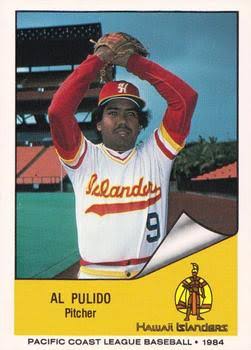
It’s safe to say when Alfonso Pulido stepped onto the field to make his Major League Baseball debut, there was some pressure.
Not only was Pulido taking to an MLB mound for the first time in his life, he was hoping to live up to the high hopes the Pittsburgh Pirates had invested into him, starting when they purchased from the Mexico City Reds in the Mexican League in July of the 1983 season.
“We have excellent reports on him,” Pirates manager Chuck Taylor said. “He throws the same stuff as [Fernando] Valenzuela. Fastball. Curve. Screwball.”
That was September, 1983. A fellow Mexican lefty, Valenzuela was just wrapping up his third full-length season in the major leagues. At that point just a two-time All Star, Valenzuela had led the National League in strikeouts and innings pitched, and all of MLB with eight shutouts innings pitched in his rookie year. At just 20 years old, he had won a Cy Young, Rookie of the Year, and finished fifth in MVP voting.
By the time 1983 was wrapping up, Valenzuela had dazzled audiences and amassed an even 3.00 ERA over 752 innings, including 38 complete games and 16 shutouts. Comparing a young, raw talent like Pulido to Valenzuela was already quite lofty praise, and that was before the man they nicknamed “El Toro” picked up a Gold Glove, three more All-Star nods, and threw well over 2,000 more innings.
Pulido also had an outstanding Mexican League reputation to live up to. A year ago, Pulido had pitched for Mexico City as a reliever, where he threw 93.1 innings to a 2.41 ERA, 1.339 WHIP, and 1.61 strikeout-to-walk ratio. Prior to the 1983 season, though, he was converted to a starter, where he improved upon those numbers with a 2.02 ERA, 1.073 WHIP, and 2.68 strikeout-to-walk ratio in 187.1 innings in the Mexican League.
In the second-game of a double-header in St. Louis, Pulido got the start as the Pirates hoped to avenge their defeat earlier in the day. He limited the Cardinals to weak contact in the first, allowing a single to right but securing two pop flies and a ground ball. In the second inning, Pulido earned his third pop fly before two batters later recording his first strikeout against Bill Lyons.
It was smooth sailing for Pulido through two, but he quickly ran into trouble in the third. Facing his pitching counterpart in Bob Forsch, the righty smacked his only home run of the season off Pulido. He barely had time to regroup before Lonnie Smith tagged him for a second home run. After Pulido issued a walk to follow up the back-to-back homers, Tanner came out to lift him from the game.
Though it was a less than perfect debut in the majors for Pulido, it was important to at least get the 26-year-old his first big-leagues as the season was winding down.
Pulido was seen as a potential candidate for a rotation job the following year, but it was clear he could probably also benefit from some seasoning in Triple-A. So when the 1984 season opened, the organization sent him to Honolulu to suit up for the Hawaii Islanders.
On a team that relied heavily upon their pitching to power their success in the Pacific Coast League that season, Pulido might have played the biggest role. He blossomed into one of the team’s best arms, throwing a professional career-high 216 innings for Hawaii in his first full season in an MLB organization. Tying Mike Bielecki for the team-lead with 28 starts, Pulido amassed a stellar 18-6 2.54 ERA and led all Islanders pitchers with a 1.093 WHIP and 2.67 strikeout-to-walk ratio.
Pulido knew how to put the team on his back. He pitched a complete game in over half of his starts, and tossed four shutouts. That was nearly half of all complete games thrown by Hawaiian starters, and was 4/14 of their shutouts.
The Tierra Blanca native was a key reason for Hawaii’s league-leading 3.16 ERA, 74 points better than the next-best team in Vancouver and 142 points below the PCL average.
Pulido was doing nearly everything right in Honolulu. Working against him, however, was the steady presence and production the parent club was getting from their big-league starters.
In Pittsburgh, the Pirates got at least 28 starts out of all five of their starters: Rick Rhoden, Larry McWilliams, John Tudor, John Candelaria, and former Islander José DeLeón. Better yet, that group averaged a 3.08 ERA as a unit, and no Pirates starter had an ERA north of 3.75.
Even in the bullpen, the Pirates had things mostly knocked down. Kent Tekulve and Don Robinson took the lion’s share of the relief work and each had great years.
No matter what Pulido did in Hawaii, the Pirates had no real need for pitching reinforcements that season. His major league work was limited to one appearance, coming in mid-September in St. Louis where he allowed three hits and was charged with two earned runs in two innings. It was an impossibly small sample size, but it was far from the bright work he routinely showed with the Islanders.
Any sustained time in the majors never came, and although Pulido’s success helped propel Hawaii to the PCL finals, his Islanders team was stunningly upset by the Edmonton Trappers, who had finished the season with a losing record. In a final that was reduced to three games due to rain, Edmonton swept Hawaii 2-0 to win their first-ever PCL title.
And unfortunately for Pulido, that disappointing ending spelled the end of his time in the Pirates organization. At the winter meetings that offseason, Pulido was traded along with left-side infielder Dale Berra and right fielding prospect Jay Buhner to the New York Yankees in exchange for infielder Tim Foli, left fielder Steve Kemp, and cash.
The trade reunited Foli with the club he won the 1979 World Series with, while it sent the son of Yankees legend and Hall of Famer Yogi Berra to the ballpark where his father played. Berra had been drafted in the first round by the Pirates in 1975, and slashed .238/.295/.346 (.641 OPS) with 46 home runs and 255 RBI through 744 games and parts of eight seasons in Pittsburgh.
In the end, this trade didn’t really work out for either side.
The 34-year-old Foli had just seven hits and 19 games left in his major league career, and played one minor league game in Miami’s organization before retiring. Kemp played 92 games for the Pirates in 1985 with average batting numbers, but was released in May the following year.
Meanwhile in New York, Berra played just 90 total games for the Yankees over two seasons, slashing .230/.285/.336 (.622 OPS) before he was released in July of 1986. The mid 1980s had sealed the end of the Berra family’s run in the Big Apple; Yogi, who had the opportunity to briefly manage his son with the Yankees, was infamously shown the door weeks into the 1986 season.
Though Buhner would go on to have a 1,472-game, Gold Glove-winning career, only 32 of those games were for the Yankees. Buhner was traded to Seattle as part of a package to acquire Ken Phelps, who never spent a full season in New York.
Pulido, meanwhile, spent the entire 1985 campaign in Triple-A Columbus, where he was able to benefit from a bit of an easier travel schedule in the International League as opposed to playing his home games in Honolulu. Now at 28 and one of the older members of the Columbus pitching staff, Pulido was one of the best arms the Clippers rostered that year.
In a team-leading 146 innings, Pulido led all regular or semi-regular starters with a 3.39 ERA, 1.288 WHIP, and 1.97 strikeout-to-walk ratio. His numbers had slipped slightly from his time with the Islanders, but the hurler had shown once again he was more than capable of handling a minor league workload. In Columbus, the team also experimented using him both as a starter and reliever, in theory giving more flexibility for when he could throw.
But the call to come pitch in the majors again didn’t come until 1986, when the Yankees promoted him in mid June to take over for the injured Tommy John (yes, of surgery fame). Pulido made his pinstripes debut on the 12th of that year, where much like his previous two major-league outings, things didn’t quite go to plan.
In five innings of work, Pulido allowed six hits, four earned runs, and three homers, although he did strike out seven and New York would eventually win. And to his credit, he followed it up with 6.2 innings of shutout as a bulk reliever, picking up the pieces after Yankees pitching had put the team in in a 7-0 hole.
After three scoreless appearances as a more traditional reliever (where he picked up his one and only MLB save), New York put him back in the bulk spot. Pulido took over in the first inning for 4.1 shutout innings on June 25th, and three days later came on in the second inning for another 4.1 innings, this time with two earned runs and a homer against.
Then as the calendar flipped to July, Pulido made his first start since his Yankees debut and pitched five full frames and started the sixth, where he allowed a career-high nine hits (and another home run) but held Detroit to four runs (three earned) and picked up his first win in the bigs.
But, inconsistencies had plagued his time in New York, and therefore his MLB chances. In his final start on the 8th, Pulido couldn’t make it past the first three outs and was rocked for seven hits, five earned runs, another two homers, and earned the loss.
He was promptly sent back to Triple-A Columbus, picking up where he left off in another great season for the Clippers with a 2.92 ERA and 1.233 WHIP, although his strikeout-to-walk ratio dropped to 1.12 over 95.2 innings. Pulido made one final appearance for the Yankees in early September, where he secured a pair of outs but handed over four hits and a run.
He gave it another go in 1987, where he went back to pitching for the Clippers. That season, however, the team used him more as a long reliever than a starter; he only made 13 starts out of 34 total appearances, and some of his numbers had taken a step back. In 126.1 innings, he recorded a 3.56 ERA, 1.164 WHIP, and 2.32 strikeout-to-walk ratio.
But his work did include helping power the Clippers to an IL title, where Columbus swept the Tidewater Tides 3-0. That was his high point in the 1987 season; another chance with the Yankees wasn’t in the cards, and Pulido had a choice to make.
At 30 years old, he was almost four years older than the average Triple-A ballplayer. He had very inconsistent and limited time in the majors, with no clear path to a full time gig unless a lot of luck broke his way.
And so, that offseason, Pulido decided to return home to Mexico. He reunited with Mexico City, and in his first year back with the Reds he led the club with a 2.52 ERA and 2.61 strikeout-to-walk ratio, to go along with a 1.242 WHIP in 139.1 innings.
His story in the grand arc of the major leagues is a blip, often forgotten. But when it came to Hawaii (and Columbus, for that matter), he was an incredibly effective and cherished arm, who still made it higher than nearly everyone else who has played this great sport.


 Fifth Avenue Sports
Leave a comment