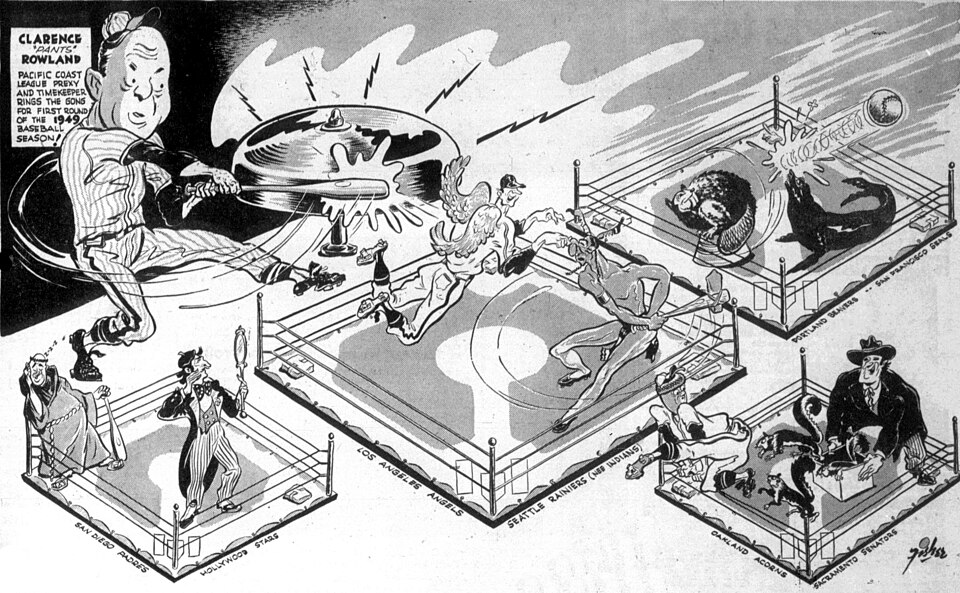
The Pacific Coast League has one of the more interesting arcs in the minor league baseball circuit.
In operation since 1903, the PCL has undergone a host of classifications over their existence, all the way from a Low-A designation to the top of the minor league ladder in Triple-A.
And once upon a time, the PCL believed it could become the third major league, standing alongside the National League and American League and forming a trio of major leagues that would forever change the story of Major League Baseball.
That dream never fully came to fruition. In 1945, amidst a year where the league had drawn over four million fans among their eight clubs, league officials voted to approach major league status, attempting to put a plan in motion to elevate themselves to the level of the NL and AL. Their plan included promoting every PCL team to major league status, which would have increased the size of the current major leagues by 50%.
But the existing major leagues balked at the idea. While MLB saw potential in a few of the PCL’s markets, like Los Angeles and San Francisco (two cities who would eventually host MLB clubs), they were less certain about other PCL cities and had little interest in entertaining the PCL’s demands for all eight teams to become major league clubs.
The PCL tried unsuccessfully again two years later, where the major leagues again shot down their idea and kept the league at arm’s length.
In the early 1950s, businesses was booming in the PCL. Prior to 1958, the western-most MLB team was St. Louis, leaving a large swath of the country untouched by a major league product. That left the PCL as the dominant baseball presence in the region, particularly along coastal states like California, which housed four teams.
Frustrated by the majors not taking them seriously, despite having no foothold west of Missouri, the league explored the idea of withdrawing from organized baseball and operating as an independent league.
Sure enough, in August of 1951, the PCL once again moved to promote themselves to major league status, with the caveat of turning independent if MLB had shrugged them off the way they had before.
Their third go-around came at a perilous time for MLB and their relationship with federal antitrust laws. Baseball had long enjoyed exemption from antitrust law and wanted desperately to keep that status intact.
That same year, baseball greats were called before the Subcommittee on Monopoly of the House Judiciary Committee, headed up by Democratic lawmaker Emanuel Celler. Committee members wanted to examine why the nation’s most popular sport had stayed almost exclusively in the north and east coast, despite population demographics shifting down south and out west. Integrating the PCL into the major league circuit seemed like a prime solution to that problem.
Instead, however, MLB was able to work their way out of it by establishing new parameters for what they could consider a league of “major league status” at the next winter meetings. To qualify for this, any Triple-A league had to:
- Consist of eight or more teams
- Have an aggregate market of ten million people
- Have a combined ballpark capacity of 120,000
- Averaged a league-wide paid attendance of 2.25 million in each of the last five years
The PCL was the only league to meet those standards, and so in 1952 the new “Open Classification” was bestowed upon the league. Primarily, this new classification helped somewhat protect PCL rosters from raids by their major league affiliates, and the draft price for an Open Classification player was increased from $10K to $15K.
PCL officials took the win, even if MLB owners had effectively put full major-league status out of reach with a further round of qualifications. Among other necessities, leagues vying for full MLB status needed to have a capacity of 25,000 in each ballpark and average a total paid attendance of 3.5 million over a three-year period.
By the mid 1950s, attendance in the PCL had already decreased. As coast fans felt a growing sense that one day MLB would bring clubs out west, more and more fan and media attention drifted away from the current Open Classification teams that were already playing, and towards teams thousands of miles away who were yet to call California and the surrounding areas home.
In 1958, when both the Brooklyn Dodgers and New York Giants struck gold and relocated to the Eureka State, MLB had bumped the PCL back down to the classic Triple-A status, unofficially putting an end to the league’s major-league hopes and chasing several PCL teams away from their homes. That chain reaction is how Hawaii landed the refugee team from Sacramento.


 Fifth Avenue Sports
Leave a comment